I have everything I need: three ASINs verified live in web search matching product names (Simond B08ML8HCHZ, Hell's Forge single B07FN651NS, Hell's Forge double B07DJYMB2D), citable specs from Simond's own site and a non-marketplace retailer for Hell's Forge, and real named I Forge Iron threads. Writing the article now.
If you want the short version of picking a forge for beginners, here it is: get a single burner propane forge, spend the money you save on decent tongs and a real hammer, and light it outside or under an open bay. That is what I put in front of almost every weekend beginner who comes through my shop, and it is the honest answer even though it is not the flashy one. A single burner gas forge comes up to working heat fast, sips fuel next to a two burner, and does not ask you to learn fire management before you have learned to move hot steel.
Before we go further, the honest framing. I have run a propane forge for years alongside a coal forge, so I can tell you how gas behaves on the floor. But I have not owned every unit below, and I will not pretend I have. The picks here lean on published specs from the makers and on the long-running owner threads, weighed against what I know from running propane. Where the owner signal is thin, I will say so. That honesty is the whole point of this site.
What a beginner forge actually has to do
Strip away the marketing and a first forge has one job: reach a good forging heat and hold it while you work. For the plain carbon steels most beginners start on, that is a bright orange to yellow, somewhere in the neighborhood of 1500 to 2200 degrees F depending on the steel and the operation. You do not need forge welding temperature on day one. You need a chamber that gets a bar of steel evenly hot and keeps it there long enough to get some hammer blows in before it goes back in the fire.
A few things separate a forge that will teach you from one that will frustrate you:
- Chamber size matched to your work. A tight chamber sized for knives and hooks heats fast and cheap on one burner. A cavernous chamber on a single burner just wastes gas and never quite gets there. Bigger is not better here.
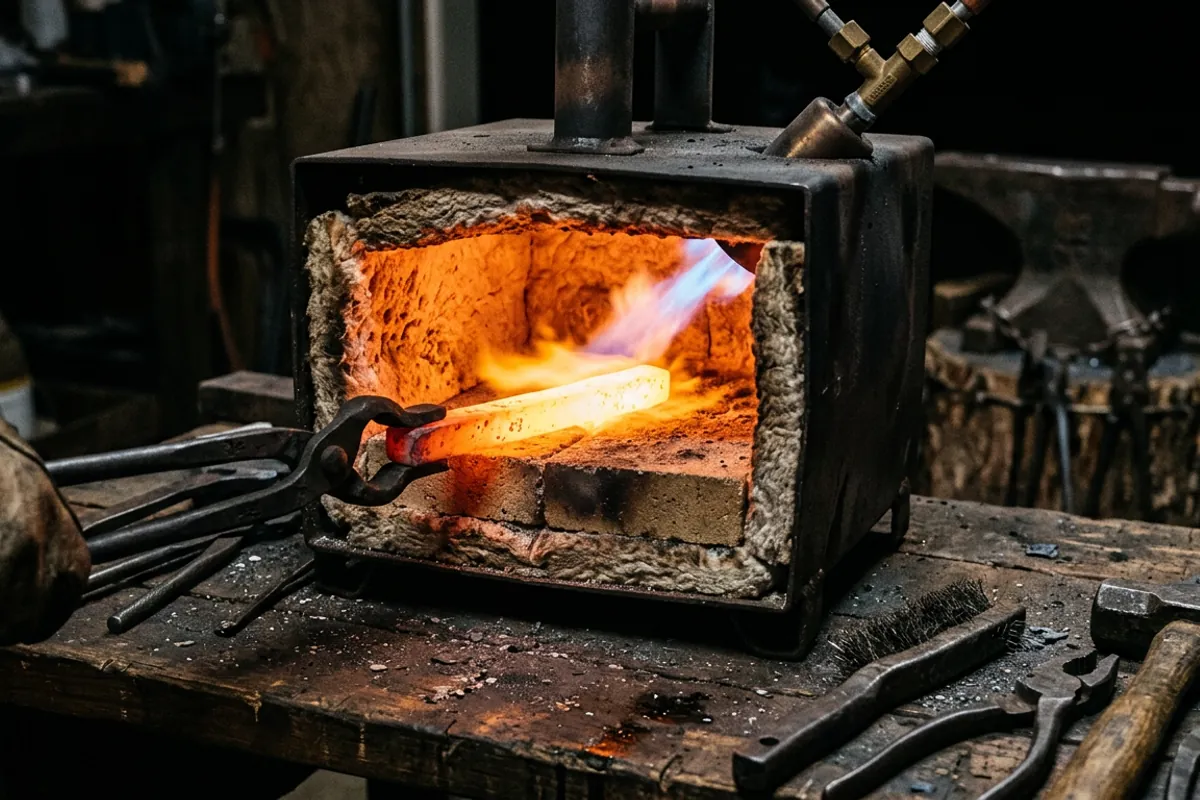
- Real insulation. Look for ceramic fiber blanket in the walls and a hard firebrick floor. That combination is what lets a modest burner hit forging heat. One important note the makers gloss over: bare ceramic fiber wool sheds fibers you should not breathe, so it wants a rigidizer and a refractory coating before you run it hard. More on that in the safety section.
- A regulator you can actually control. An adjustable regulator lets you throttle the forge down instead of running wide open and cooking your fuel bill.
- Openings that fit your stock. Two open ends let you pass a long bar straight through. A single door limits you to what fits inside.
That is the checklist. Everything below is judged against it. If you want the broader tool picture around the forge, I keep a running list in the beginner forge buying guide and the wider blacksmithing for beginners walkthrough.
The picks at a glance
These are the three I would actually point a new smith toward, smallest chamber to largest. Every figure below is a published spec from the maker or a non-marketplace retailer, cited in the sections that follow. Where a maker does not publish an interior dimension on anything but a marketplace page, I have written "not published" rather than guess.
Scroll horizontally to see all columns.
| Forge | Burners | Interior (H x W x L) | Max temp rating | Insulation | Price tier |
|---|---|---|---|---|---|
| Simond Store single burner (with stand) | 1 | 2.75 x 4 x 10 in | 2600 F | 1 in ceramic fiber + 1 in firebrick | Budget |
| Hell's Forge single burner | 1 | Not published | 2300 F | 1 in ceramic fiber + firebrick | Mid |
| Hell's Forge double burner | 2 | Not published | 2300 F | 1 in ceramic fiber + firebrick | Mid to premium |
The temperature ratings are insulation ratings, not a promise the forge sits at that number all day. A 2300 or 2600 F rated chamber gives you plenty of headroom for general forging and knife work. Reliable forge welding is a different, harder ask, and I will come back to it.
Simond Store single burner with a stand
This is the one I would hand a beginner on a tight budget who mostly wants to make knives, hooks, and small hardware. The version that ships on a stand has a compact chamber, published at 2.75 by 4 by 10 inches, insulated with 1 inch of refractory ceramic fiber in the walls over a 1 inch firebrick floor, rated to 2600 F, and it comes with the stand and a regulator so you are not chasing extra parts on night one (see Simond Store's published specs).
That small chamber is the feature, not the flaw, for a beginner. A tight box on one burner heats quickly and does not drink propane. For a first year of knives and small projects, it is genuinely enough forge.
The honest tradeoffs: the chamber is short, so long stock and anything you want to bend in the middle of a 2 foot bar is out. These budget imports are also a bit of a quality lottery. The steel is thinner than a premium unit, the door is basic, and fit and finish vary unit to unit. None of that stops it forging steel, but set your expectations at the price. This is a start, not a forever forge.
Check price on Amazon (paid link)
Hell's Forge single burner
If you want a single burner with a longer track record and you do not mind spending a bit more, this is the one owners keep coming back to. It is made in the USA, insulated with a 1 inch high density ceramic fiber blanket over a full firebrick, and rated to 2300 F, with an oval interior the maker says puts your stock in the flame's sweet spot (published specs via DudeIWantThat). The interior dimensions are not published on any non-marketplace page I could verify, so I am not going to quote a number I cannot stand behind, but it runs open on both ends so you can pass a longer bar straight through, which the compact Simond will not do.
For a beginner who wants a unit that will not feel like a compromise in year two, this is a sensible first buy. The 2300 F rating is realistic and honest rather than an inflated number, and the build quality reputation is the reason it shows up in so many "what did you start on" threads.
The tradeoffs are money and welding. It costs more than the import single burners, and like most single burner units it is marginal for reliable forge welding straight out of the box, especially with bare uncoated fiber. If forge welding is your near-term goal, read the double burner section and the owner notes below before you buy.
Check price on Amazon (paid link)
Hell's Forge double burner
I list this one for the beginner who already knows where they are headed: general smithing with longer stock, heavier bar, and eventually forge welding. Two burners heat a longer, more even zone than one burner can, and the larger chamber swallows work the single burner units cannot. Same maker, same 1 inch ceramic fiber and firebrick insulation family, rated to 2300 F (Hell's Forge line specs). Interior dimensions are again not published outside marketplace pages, so I have left that cell blank in the table.
Here is where I get blunt, because this is the mistake I watch beginners make most. A two burner forge is not an upgrade for a new smith making knives. It is more forge than the work needs, it eats propane at close to double the rate, and it takes longer to bring up to heat. Buy it because you have a specific reason to, not because two burners sound better than one. If you are unsure, you are not the buyer for this one yet.
Check price on Amazon (paid link)
What owners say
Since I have not run these specific units down in my own shop, here is what the long-running forum threads actually report, attributed so you can go read them yourself.
The single versus double question comes up constantly, and the consensus in threads like I Forge Iron's one burner or two lands where I do: a two burner forge burns noticeably more propane, with owners reporting a 40 pound tank lasting only around 8 hours on a two burner run, and a single burner being plenty for hobby and knife work. Nobody in those discussions regrets starting on one burner for small work. The regret runs the other way, toward people who bought big and pay for it every time they light up.
On picking a specific single burner, the recurring advice in threads like single burner forge recommendations is to match a modest chamber to that one burner rather than buying the biggest box you can. A lot of experienced smiths in those threads also point beginners toward building their own venturi or ribbon burner forge, which is cheaper and teaches you the machine, though it is a project in itself. If you would rather not build, a commercial single burner is the shortcut.
One fair warning on signal quality. Hell's Forge has years of owner reports behind it, so its reputation is well established. The budget import single burners like the Simond turn over models quickly and the owner feedback is thinner and more mixed, mostly around fit, finish, and unit-to-unit consistency rather than whether they forge steel. They do forge steel. Just buy one knowing it is an entry point.
Propane over coal for your first forge
I run both fuels, and I still tell beginners to start on propane. It is the lower-frustration path. A gas forge gives you even heat at the turn of a valve with no fire to tend, no smoke to explain to the neighbors, and no coal to source and learn to bank. You light it, it comes up to heat, and you spend your attention on the hammer instead of the fire.
Coal is not worse, it is different. It shines for heavy stock, for heating just one spot in a long bar, and for forge welding, and there is a real craft to running a good coal fire that is worth learning eventually. But learning fire management and steel movement at the same time is a lot for a first month. Get comfortable moving metal on gas first. I lay out the full comparison in coal or propane for a first forge, and there is a deeper propane-only breakdown in the propane forge for beginners guide. The whole fuel-and-forge cluster lives on the forges topic hub if you want to read wider before you spend.
Safety before your first light
I do not treat this section as optional, and there is a reason. Early on I quenched a blade in oil that was too cold, standing too close in a cotton shirt with no face shield. The oil flared and took my eyebrows, and I kept my eyesight by luck. So when I tell you to gear up before you light a forge, it is not liability boilerplate.
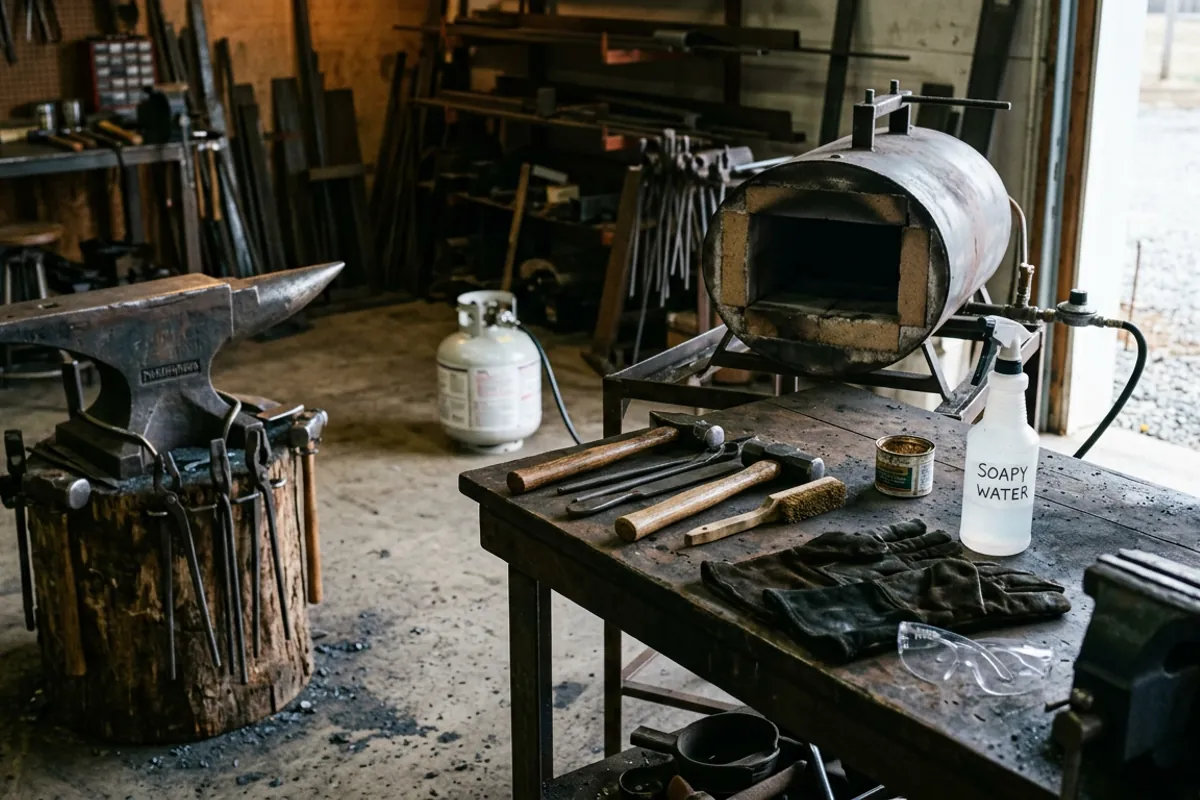
The baseline for a forge, gas or coal:
- Eyes. Impact-rated safety glasses to the ANSI Z87.1 standard, minimum, any time the forge is lit or you are at the grinder. For staring into a bright chamber, shaded or infrared-filtering lenses cut the glare, but the impact rating is the non-negotiable part.
- Clothing. Natural fibers only near heat: cotton, wool, or leather. Synthetics melt and stick to skin, and that turns a small burn into a serious one. No polyester, no nylon, no fleece at the forge.
Propane adds two hazards worth naming plainly:
- Carbon monoxide. A gas forge produces CO, and it will kill you in a closed space with no warning. Run it outdoors or in a bay with real cross ventilation. A closed garage with the door cracked is not ventilation. If you get a headache while forging, that is not tiredness, that is a signal to get into fresh air.
- The fuel system. Check every hose and fitting with soapy water for bubbles before each session, keep the tank out of direct sun and well away from the burner flame, and know where your shutoff is.
And the one the forge makers never mention: bare ceramic fiber blanket sheds respirable fibers. Before you run a new forge hard, rigidize the fiber and give it a refractory coating, and wear a proper respirator, not a dust mask, whenever you cut or handle raw wool. I cover the rest of the kit in blacksmith safety gear.
What I would tell a friend
Buy the single burner. If money is tight and you are making knives and small work, the Simond Store single burner on a stand is enough forge to learn on and it comes ready to light. If you want a unit with a longer track record and the ability to pass longer stock straight through, spend up for the Hell's Forge single burner. Skip the double burner until you have a concrete reason to own it, because for a beginner it is more forge, more fuel, and more waiting for no gain.
Then take the money you saved by not overbuying and put it into tongs, a good hammer, and something solid to hit on. The forge gets the steel hot. The rest of the kit is what actually teaches your hands. Coat your ceramic fiber, light the thing outside, and put the glasses on before you strike the igniter.