Blacksmithing gifts are one of the harder things to shop for, and I get asked about them more than almost anything else on this site. It usually comes from someone who does not smith: a spouse, a kid, a friend who watched a forging show and knows their person spends weekends beating on hot steel in the garage. They want to buy something real and useful, and they are terrified of spending good money on a tool that ends up in a drawer. That fear is well founded. A blacksmith's shop is a personal, opinionated place, and the wrong gift is genuinely easy to buy. But there is a whole category of things a smith will always use, always run out of, or never think to buy for themselves, and that is where you want to shop. I have been at this about twenty-five years, I teach weekend beginners, and I have watched a lot of well-meant presents miss. Here is how I would think about it, owner to owner.
Start with what a smith actually reaches for
The single best guiding principle for blacksmithing gifts is this: buy the thing that gets used up, or the thing that gets used every single session, not the centerpiece. Non-smiths gravitate toward the anvil and the forge because those are the icons. Those are also exactly the tools a working smith has already chosen with enormous care, or is saving up to choose that way. My anvil is a 148 lb Trenton I call Bessie, and I would not have traded the choosing of her for any surprise, however generous. The heavy iron is a decision, not a gift.
What a smith reaches for constantly is smaller and less romantic. Consumables. Hand tools. Safety gear. Reference material. The stuff that quietly makes every forging session better and that most of us are too cheap or too busy to keep stocked. If you shop that shelf instead of the showroom floor, it is very hard to go wrong. If you want the fuller picture of how a home shop is actually equipped, the walkthrough in what a beginner blacksmith actually needs to start lays out the real priority order, and it doubles as a shopping map for anyone buying for a smith.
Safety gear is the gift nobody buys themselves
If you take one thing from this article, take this: safety gear is the most valuable and most under-bought category in the entire craft, which makes it the best blacksmithing gift there is. I say that with a scar where my eyebrows used to be. Early on I quenched a blade in oil that was too cold, standing too close in a cotton shirt with no face shield, and the oil flared up and took my eyebrows off my face. I kept my eyesight by luck, nothing else. I have never once regretted spending money on protection since, and I have met very few smiths who buy themselves as much of it as they should.
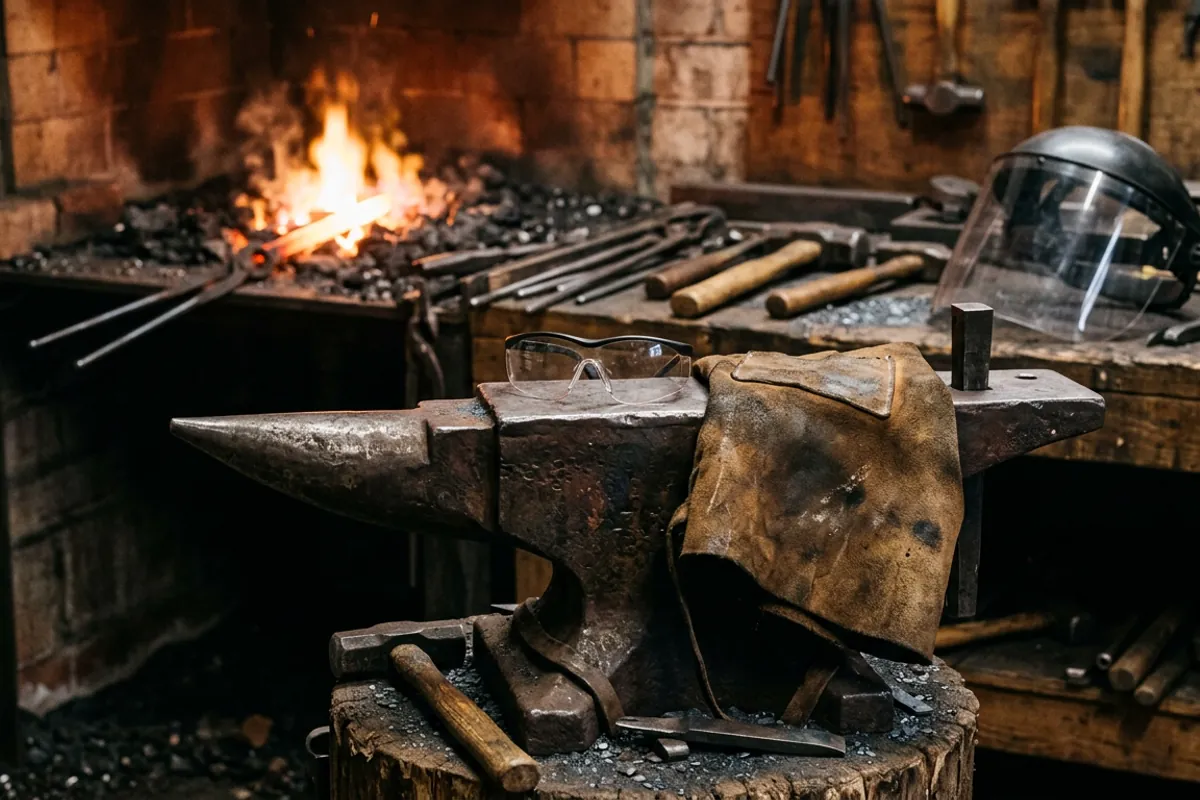
Eye protection is the anchor. You want safety glasses rated to the ANSI Z87.1 standard, which is the real, checkable mark stamped on the frame or lens. That rating means the eyewear passed impact testing, and it is not the same as fashion sunglasses that happen to be dark. For anyone doing grinding, a full face shield over Z87.1 glasses is the right call, because the shield stops the sparks and slag while the glasses stop what sneaks under. This is genuinely a place where the standard matters and the marketing does not.
The other reliable safety gifts: a proper leather apron, real leather work gloves, and hearing protection. On clothing, the rule is natural fibers over synthetics near heat. A cotton or wool shirt might scorch, but a polyester one melts onto skin, and that is a much worse burn. A heavy natural-fiber apron is a gift a smith will wear every session for years. I wrote out the whole what-matters-and-what-to-skip list in blacksmith safety gear: what matters and what to skip, and it is the piece I would hand anyone shopping this category, because there is junk PPE out there too and the standards are how you tell the difference.
Consumables never sit on a shelf
The beauty of consumables as a gift is that there is no wrong choice within a fuel type, and nothing to gather dust. A smith burns through fuel, abrasives, and finishing supplies constantly, and restocking is exactly the chore we put off.
If your smith runs a coal forge, good smithing coal is a genuinely thoughtful present, because the quality varies a lot and clean-burning coal is worth having. If they run propane, a filled tank or two is boring and perfect. Grinding abrasives are the same story for anyone doing blade or finish work: belts and flap discs wear out fast, cost real money, and get rationed. A stack of fresh belts in the right size is a gift that gets consumed with a smile.
There is one catch worth knowing. Coal and propane are not interchangeable, and a coal smith has no use for a propane accessory or the reverse. So before you buy fuel, find out which forge they run. If you are not sure and cannot ask without spoiling it, skip fuel and buy abrasives or finishing oil, which every shop uses regardless. The tradeoffs between the two fuels, and why a smith commits to one, are laid out in coal or propane: which first forge makes sense, and skimming that will tell you which camp your person is in.
Hand tools you can buy without knowing their shop
This is the category people most want to shop and where they most need a steady hand, because tools are personal but not all of them are. Some hand tools are safe to buy blind, and some are not.
The safe ones are the tools where a good version is a good version for almost anybody. A quality wire brush for knocking scale off hot work. A soapstone marker and holder for laying out lines. A center punch. Layout and measuring tools. A good pair of tongs sized to common stock is usually welcome too, because most of us never have quite enough tongs and always want another pair that fits a size we keep grabbing for. If you go the tongs route, the honest breakdown of what actually grips versus what looks the part is in the blacksmith tongs I would buy first, and the ones I would skip, and it will keep you from buying a pretty pair that does not close right.
The tools to be careful with are hammers and anything that lives against the hand for hours. A smith's hammer is chosen by weight, handle, and feel, the way a carpenter chooses a favorite. My hammer weight is my hammer weight because of twenty-five years of my particular wrist. Handing someone a mystery hammer of the wrong weight is a kind gesture that ends up on the rack. If you want to give a hammer, the safer version of that gift is a gift toward a hammer, letting them pick the weight, rather than a surprise off the shelf.
Gifts for someone who has not started yet
Buying for a person who is curious but has not lit a forge is a different problem, and honestly an easier one. Here you are not equipping a shop, you are lowering the barrier to the first swing. The worst thing you can do is buy a total beginner a full kit of the wrong stuff, because a bad first anvil or a toy hammer teaches bad habits and sours the whole experience.
The gift that actually starts people is a class. A weekend introductory course at a local guild or craft school puts a hammer in their hand with a real smith watching, and it does more than any pile of gear. I teach these, and I have watched a two-day class turn a curious person into a committed one, or gently show them it is not for them, either of which is worth knowing before anyone buys an anvil. If a class is not in reach, a well-chosen starter kit is the next best thing, but the emphasis is on well-chosen. What separates a kit that teaches from a kit that frustrates is covered in the beginner blacksmith kit I would actually buy first, and I would read that before spending a dollar on a boxed set.
For a beginner you also do not need to buy an anvil at all. New smiths learn fine on a chunk of steel, and I started on a cut length of railroad track clamped to a stump. So resist the urge to make the anvil the gift. If the person turns out to love the craft, they will want to choose their own heavy iron anyway, the same way I chose Bessie, and the guidance in how to buy an anvil without wasting your money is worth passing along so they buy well when the time comes.
Books, references, and the gift of knowing
Do not overlook knowledge as a gift. A smith at any level is always learning, and a good reference earns its keep for decades. General blacksmithing manuals, bladesmithing books, and solid metallurgy references are all durable, personal, and impossible to have too many of.
I will give one honest caution here, because accuracy is the whole point of this site. A lot of blacksmithing lore, printed and online, is confidently wrong about heat treating and steel science in particular. Numbers get copied from book to book without ever being tested. If your smith is serious about blades and heat treat, steer them toward genuinely tested sources: Knife Steel Nerds does real, published metallurgy work, and it is where I send anyone who wants to argue about hardening temperatures instead of guessing at them. A gift subscription or a pointer to real testing beats a glossy book of repeated myths every time.
What I tell people who ask me directly
When someone corners me at the club and asks what to buy their smith, I give them the same short answer every time. If you know nothing about their shop, buy safety gear or a class, because those are almost impossible to get wrong and both are chronically under-bought. If you know a little, buy consumables in the right fuel and the right abrasive sizes. If you know their shop well, and only then, consider a specific tool, and even then lean toward the tools chosen by size and quality rather than by personal feel.
The thread through all of it is humility about how personal this craft is. The gifts that land are the ones that respect the smith's own choices instead of making the big choices for them. Nobody wants a surprise anvil in the wrong weight or a hammer that fights their wrist. Everybody wants fresh belts, real eye protection, a full fuel tank, and a nudge toward learning more. Shop that shelf and you will give a blacksmithing gift that gets used until it wears out, which is the highest praise any tool in my shop can earn. If you want to hand your smith a single starting point to browse from, the getting started hub gathers the pieces I would put in their hands first.