Blacksmithing starter kit is the phrase that sells more boxed junk than almost anything else in this hobby, so let me save you the first mistake I watched a dozen weekend beginners make: do not buy the all-in-one "kit" in a single carton. The verdict up front is that you assemble your own starter kit from four things that matter in this order, heat, an anvil with mass, one honest hammer, and one set of tongs, and you put a pair of ANSI Z87.1 glasses on your face before any of it gets hot. Below I lay out the specific pieces I would hand a beginner and the tradeoffs on each. Fair warning on method: I have run a coal forge and a propane forge for years and I own an anvil I have put more hours on than I can count, but the budget cast anvil, the import tongs set, and the box-store hammer in this guide are not bench tests I ran. They are published specs and owner reports from the forums, weighed against what I know from the floor of my own shop. Where the signal is thin, I will say so.
What a blacksmithing starter kit actually is
A blacksmithing starter kit is not a product. It is a short list of tools that lets you take a bar of mild steel, get it to a working orange, and move it on a hard surface without hurting yourself. That is the whole job at the start. Everything past that, the swages, the fullers, the second and third hammer, comes later once you know what you are actually making.
The boxed "kits" get this wrong in a predictable way. They pad the count with a fistful of cheap tongs, a light ball pein that is the wrong shape, and a "anvil" that is a painted cast-iron doorstop, then they skip the one thing you cannot skip, which is heat. A kit with no forge is not a starter kit. So when you see a listing bragging about a fifteen-piece set, read it as one or two useful items surrounded by filler. I would rather you buy four good pieces than fifteen mediocre ones. If you want the fuller argument on the minimum list, I laid it out in the black smith tools you actually need to start and in the beginner blacksmith kit I would actually buy first. Start there and then come back for the specific picks.
The other thing to understand is that a starter kit is a floor, not a ceiling. Nothing here is a tool you outgrow and throw away. A decent anvil outlives you. A good hammer gets rehung, not replaced. Buy the pieces once, buy them honestly, and you are set for years.
The starter kit at a glance
Here is the field laid out with published specs only. Where a maker does not state a figure, it says so. Prices stay qualitative because I will not quote a moving marketplace number at you.
Scroll horizontally to see all columns.
| Piece | Weight or size | Material | Published hardness | Tier |
|---|---|---|---|---|
| VEVOR single horn anvil (66 lb) | 66 lb, 10.35 x 3.46 in face | Cast steel | 50 HRC (maker) | Budget |
| Seymour HB-3 cross pein hammer | 3 lb head, 15 in hickory handle | Forged head, hickory handle | Not published | Budget to mid |
| 6-piece beginner tongs set | About 16 to 18 in reach | Steel | Not published | Budget |
| 3M Virtua safety glasses | ANSI Z87.1 rated | Polycarbonate lens | Not applicable | Budget |
The anvil figures come from VEVOR's own product page, the hammer figures from Seymour Midwest. The tongs and glasses makers do not publish hardness or handle specs I would stake a table on, so I left those as not published rather than invent them.
The anvil: mass before anything else
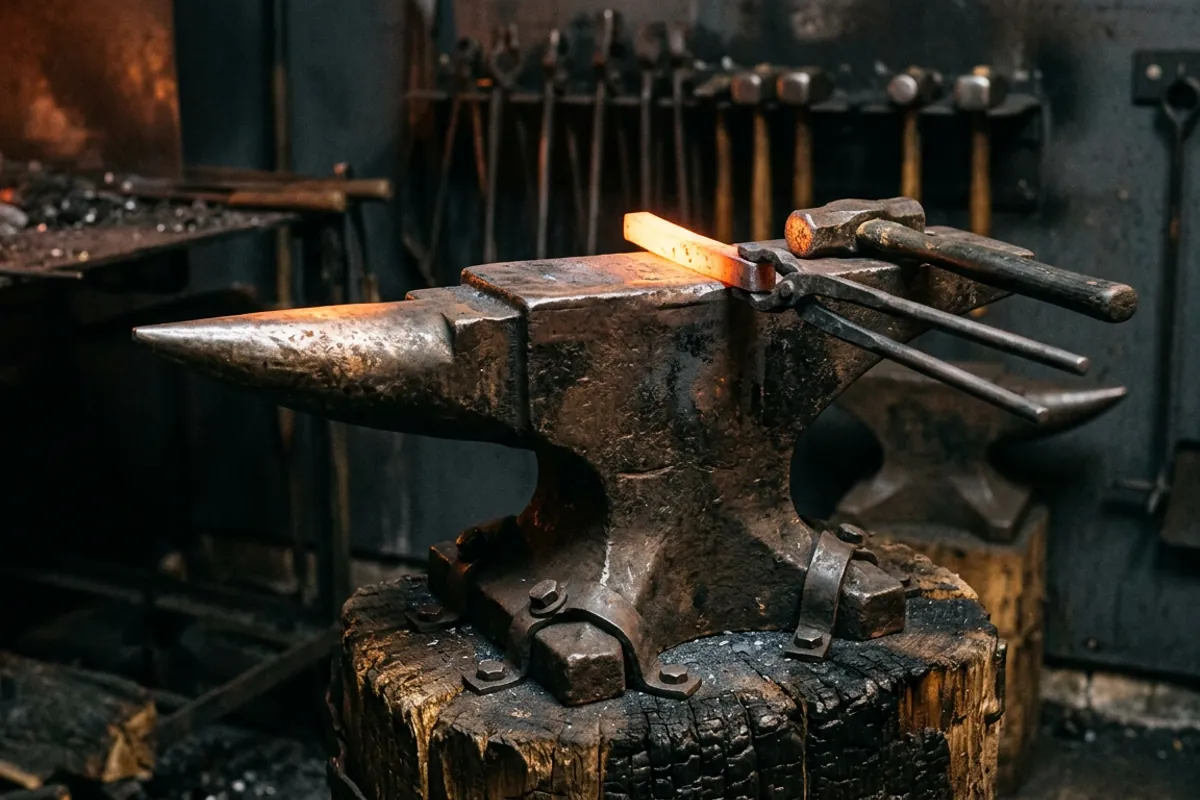
The anvil is where a starter kit lives or dies, and it is where the boxed sets cheat hardest. A real anvil gives you rebound, the hammer bouncing back off the face instead of dying in the metal, and rebound is a function of a hard face and enough mass under it. Cast iron gives you neither. Cast steel, heat treated, gives you a usable amount of both.
The budget honest option here is the VEVOR single horn cast steel anvil. The 66 lb version is the one people reach for first, and VEVOR publishes a 50 HRC face hardness and a 10.35 by 3.46 inch working face on it. That is a real London-pattern shape with a horn, a face, a hardy hole, and a pritchel hole, which already puts it ahead of the doorstops.

Here is my honest read, and it is the most important sentence in this guide: 66 lb is the light end of usable. It will teach you, it will make hooks and leaves and a first knife, but a light anvil moves and rings and gives back less energy per blow than a heavy one. If your budget stretches at all, go heavier. VEVOR makes the same pattern in bigger weights, and a heavier anvil is not a luxury, it is the single best return on money in the whole kit. I worked out the why on mass in what size anvil do you actually need, and it is worth reading before you click buy. The short version: buy the most anvil weight you can afford, then bolt or strap it to a solid stand so it does not dance. A 66 lb anvil that is loose on a wobbly stump feels worse than a 100 lb anvil sitting dead solid.
The hammer: one, and keep it simple
You need exactly one hammer to start. Not a set. A cross pein in the two to three pound range does everything a beginner asks of it, drawing out, flattening, and moving metal, and the cross pein face is the one you will actually use to spread steel. Skip the double-jack and skip the tiny jeweler hammers.
The pick I would point a beginner at is the Seymour HB-3 cross pein. Seymour Midwest publishes it as a 3 lb forged head on a 15 inch hickory handle, and hickory is what you want under a forging hammer because it soaks up shock. Check price on Amazon (paid link).
The honest tradeoff is weight. Three pounds is on the heavier side for a raw beginner, and if you have never swung a hammer for an hour straight, it will find muscles you did not know about. A lot of smiths, me included, tell new people to start closer to two to two and a half pounds and let their technique carry the blow instead of their shoulder. If your arm is not sure yet, size down. A hammer that wrecks your elbow in twenty minutes is not a bargain at any price. Either way, dress the face lightly, knock the sharp factory edges off so they do not leave marks in your work, and rehang it if the handle ever loosens. For the longer argument on hammer weight and shape I wrote the blacksmith hammer I would hand a beginner.
Tongs: the one place a set makes sense
Tongs are the exception to my no-set rule, and here is why. You need tongs sized to your stock, and at the start you do not yet know what stock you will be holding, so a spread of a few sizes actually earns its keep. A six-piece beginner set typically gives you a couple of V-bit tongs for round and square stock, a flat jaw, a pick-up, and a scroll tong, which covers most of what a first year throws at you.
The set I would start with is a standard six-piece beginner tongs kit. Check price on Amazon (paid link). These import sets run long, roughly 16 to 18 inches, which keeps your hands back from the heat, and that reach is a safety feature, not a nicety.
Now the honest part, because these sets have a real reputation to manage. The forums are blunt about import tongs: the jaws often do not close cleanly on the stock out of the box, the rivet can be sloppy, and you may have to heat them and adjust the jaws to get a real grip. That is not a dealbreaker for a beginner, adjusting a pair of tongs is itself a good early lesson, but go in expecting to tune them rather than expecting perfection. A tong that does not hold your work will drop hot steel on your boot, so test each one cold on the size it is meant for and fix any that do not bite before you trust them with something orange. More on picking and fixing tongs in the blacksmith tongs I would buy first.
Eye protection is not optional, and I mean it
This is the section I will not soften, because I have the story to back it. Early on I quenched a blade in oil that was too cold, standing too close in a cotton shirt with no face shield. The oil flared, and it took my eyebrows. I kept my eyesight by luck, not by sense. Do not run on luck.
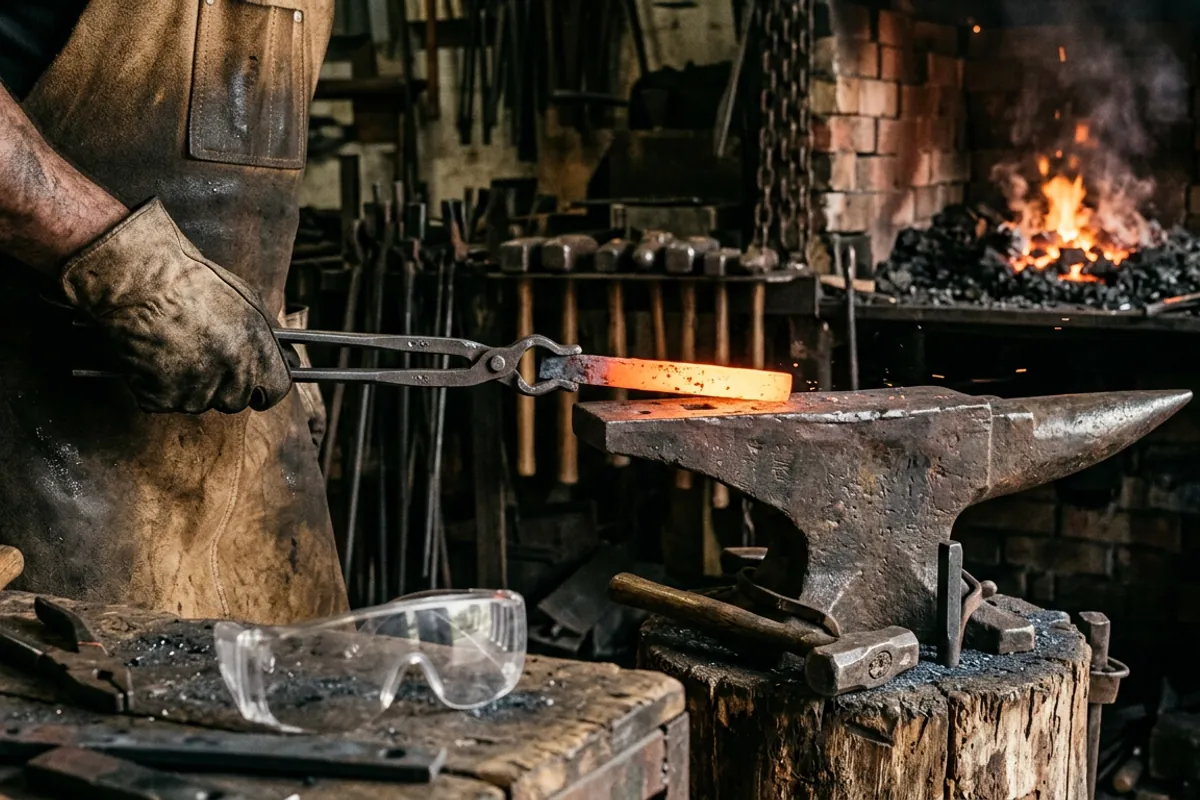
Buy real eye protection before you buy anything else in this kit, and buy protection rated to ANSI Z87.1, which is the American standard for impact eyewear. That rating is the whole point: it means the lens is tested to take a hit from flying scale, a snapped wire brush bristle, or a chip off a cold chisel without shattering into your eye. Fashion sunglasses are not this. The 3M Virtua is a cheap, honest pair that carries the Z87 rating and a polycarbonate lens. Check price on Amazon (paid link).
Wear them any time steel is hot and doubly at the grinder, where hot particles come off fast and straight. While we are here: cotton, wool, or leather near the forge, never synthetics, because polyester melts to your skin instead of just scorching. I put the full rundown in blacksmith safety gear: what matters and what to skip. Read it. This is the part of the hobby that does not give second chances.
The forge: the piece no boxed kit includes
Here is what the carton on the shelf leaves out. Without heat you do not have a starter kit, you have a paperweight and a hammer. So the real first decision is how you make heat, and that comes down to coal or propane.
For most beginners I steer toward propane. A propane forge lights in a minute, holds an even heat, needs no fire tending, and lets you spend your attention on the steel instead of the fire. That is why my propane forge does most of the day-to-day work in my shop. Coal gets hotter in a concentrated spot, is what you want for heavy stock and forge welding, and is what runs my other forge, but it comes with fire management, smoke, and a fuel supply to sort out. Neither is wrong. For a first forge and a first year, propane is the gentler teacher. I walked through the whole tradeoff in coal or propane: which first forge makes sense, and it is the one decision in this kit I would not rush.
Budget the forge as its own line, not an afterthought, because it is the tool that makes the other three do anything. A small single-burner propane forge is plenty to start.
What owners say
Since the anvil, tongs, and hammer here are not tools I have personally run into the ground, here is the forum signal, attributed.
On beginner hammers and tongs, the long-running I Forge Iron thread recommendations for a beginner's hammers and tongs lands where I did: one hammer in a sane weight, tongs sized to your stock, and do not overbuy at the start. The consensus is that technique beats hammer weight, which is exactly why I tell nervous beginners to size down rather than up.
On tongs specifically, the thread tongs: roll your own or buy them captures the split. Plenty of experienced smiths make their own, but the honest read for a first-year beginner is that a cheap set gets you gripping hot steel now, and learning to make tongs is a project for after you can already hold the work. The recurring complaint on the import sets is fit and rivet play, the same thing I flagged above, so this is real owner consensus and not just my hunch.
On the budget cast anvils, the signal across r/Blacksmith and the forums is consistent and worth respecting: cast steel from a maker like VEVOR is a genuine starting anvil, but light weights move and give back less, and a heavier honest anvil is the better long-run buy. Nobody there is calling a 66 lb cast anvil a forever tool. They are calling it a real place to start, which is the same thing I am telling you.
What I would tell a friend
Buy four things, not a box. Get heat sorted first, and for a first forge that means propane unless you already know you want coal. Put your money into anvil mass before anything else, because the anvil is the tool you feel in every single blow, and if you can afford to go heavier than 66 lb, do it. One cross pein hammer in a weight your arm can actually swing, sized down if you are unsure. One tongs set, expecting to tune the jaws before you trust them. And the glasses go on your face before the steel gets warm, every time, no exceptions, because I have felt what happens when they do not.
The one to skip is any listing that calls itself a complete kit and has no forge in it. That is the tell that the person who packed it has never lit one. Start from the topic hub, getting started, build the kit yourself, and you will spend less and end up with better tools than the carton would ever have handed you.