Most people who go looking for blacksmithing ideas already have a forge lit and a bar of steel cooling in their hand, staring at it wondering what it wants to be. I have been there more times than I can count, and after about twenty-five years at the anvil I can tell you the problem is almost never a shortage of things to make. The problem is picking ideas that actually move your hands forward instead of just producing another lump of scrap for the bucket. This is a reference piece, not a shopping list. I want to give you a way of thinking about projects so that the ideas you chase teach you something, keep you safe, and slowly turn a beginner into a smith. If you are brand new, read this next to the Getting started hub, because the two go together.
Where blacksmithing ideas actually come from
The good ideas do not come from a Pinterest board. They come from the skills you are trying to build. Every forging operation in the craft comes down to a short list of fundamentals: drawing out (making stock longer and thinner), upsetting (making it shorter and fatter), bending, twisting, punching, drifting, and joining. A hook is a drawing-out and bending exercise. A leaf is drawing out, then spreading, then veining. A bottle opener is a punch, a drift, and a shaping. Once you see projects as bundles of those fundamentals, you stop hunting for cute objects and start choosing ideas by which skill they force you to practice.
That reframing matters because a beginner who picks projects at random tends to keep repeating the two or three moves they are already comfortable with and avoiding the ones they are bad at. You get good at what you practice, so if every idea on your list is a variation of the same hook, you plateau. I keep a running list on the shop wall, but I organize it by the move, not by the finished thing. When my punching is sloppy, I go find an idea that is mostly punching and drifting. That is how ideas serve the skill instead of the other way around.
Start with ideas that teach one skill at a time
The single most common mistake I see in weekend beginners is reaching for an idea that stacks five hard skills on top of each other before they can reliably do any one of them. A pattern-welded chef's knife is a magnificent object and a terrible first project. You will fail at the forge weld, the heat treat, the grind, and the handle all at once, and you will not know which failure caused the finished thing to disappoint you.
Pick ideas that isolate a variable. Your first month of blacksmithing ideas should be things where only one part is hard and everything else is forgiving. A wall hook is the classic for a reason: the whole project is drawing a taper and making a clean bend, and if you overheat it or hammer a cold shoulder, you can see exactly what went wrong. I hand a hook to nearly every beginner who comes through, and I wrote out the whole logic of why in the blacksmith hook explainer. A J-hook, an S-hook, a simple coat hook: same skills, gentle stakes.
From there the natural progression is a leaf key fob, a small poker, a spoon or spatula from flat stock, and a bottle opener. None of these will land you a commission, and that is the point. They are reps. I laid out a whole ladder of these in the beginner projects piece, and the bottle opener walkthrough covers one of them start to finish. The goal in month one is not a mantle full of treasures. It is a hundred clean tapers and fifty square bends that you did not have to think about.
Blacksmithing ideas for the shop itself
Here is a category new smiths overlook, and it is the best value in the whole craft: make the tools you use. A working shop is full of things you would otherwise buy, and forging them teaches you real skills while filling out your bench for the cost of scrap.
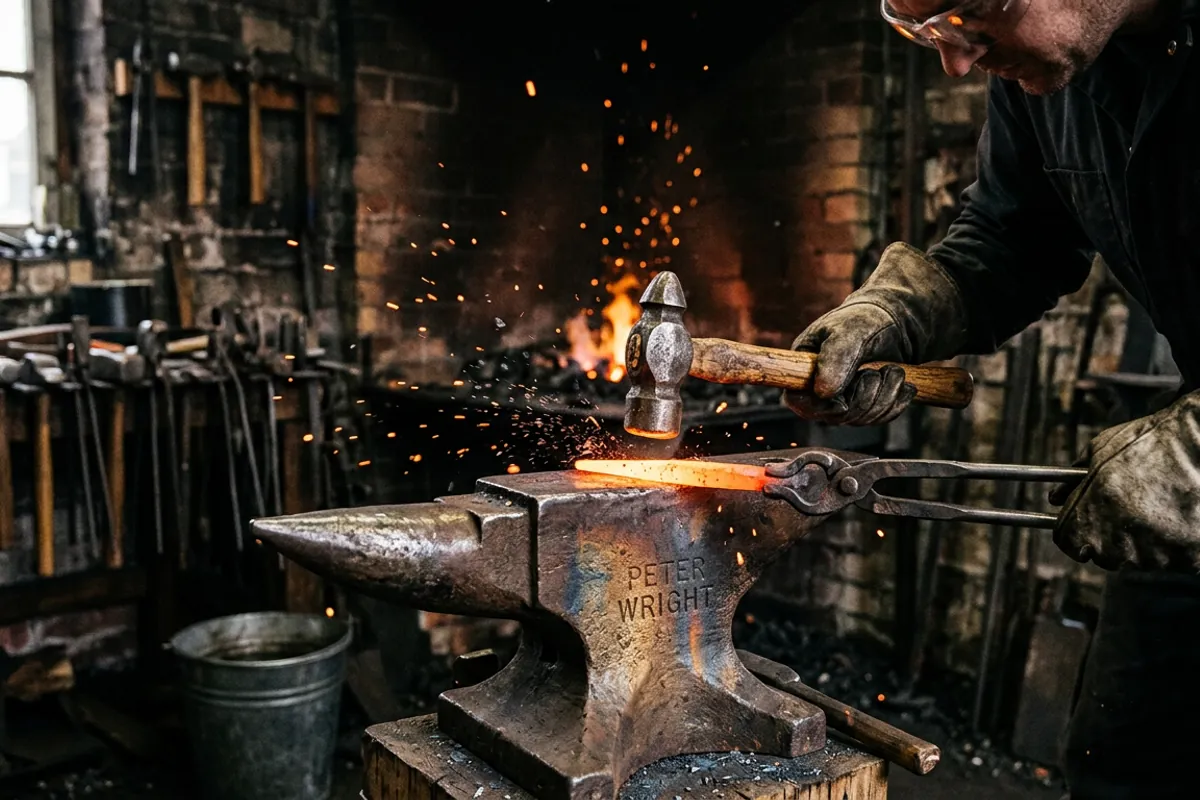
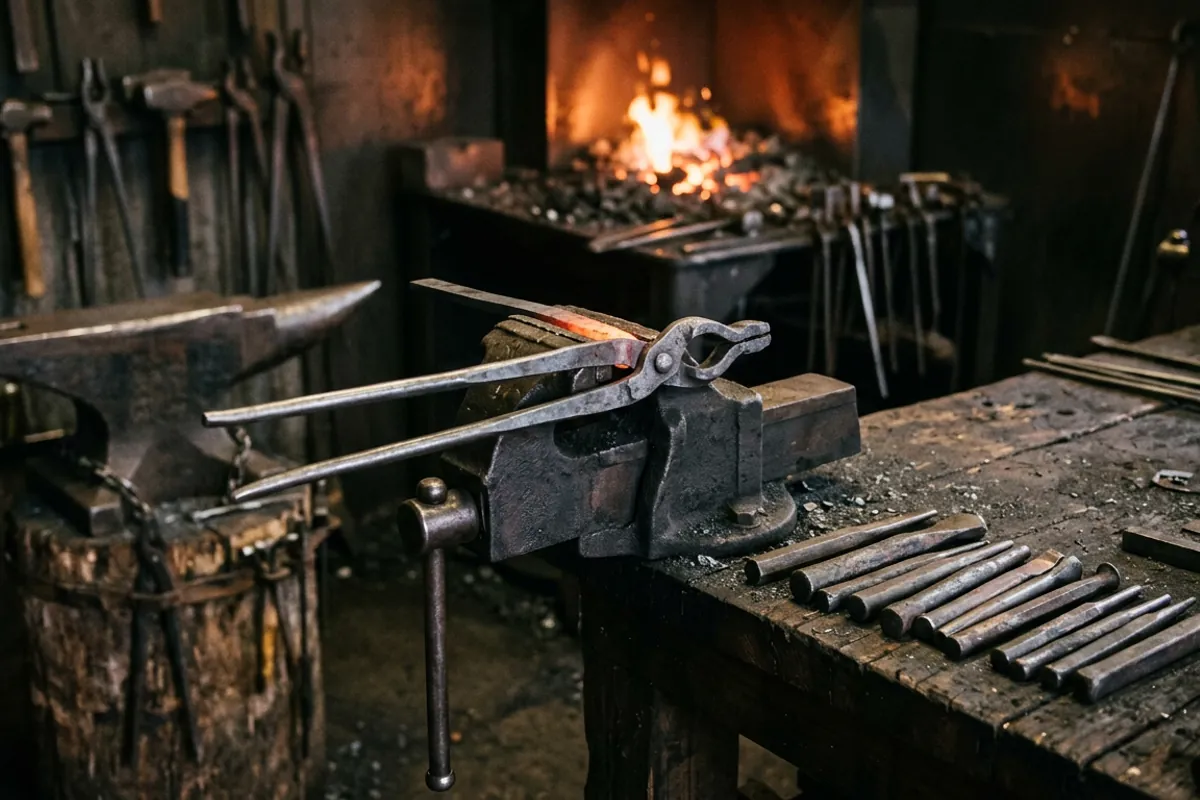
Tongs are the obvious one. A dedicated pair of tongs for every stock size is a luxury when you buy them and a necessity when you actually work, so beginners learn to forge their own. The reins teach you drawing out over a long distance, the boss teaches you controlled upsetting and punching, and the bit teaches you fitting steel to steel. Your first pair will be ugly and probably will not track true. Your fifth pair will be a tool you actually reach for. Punches, drifts, hardy tools, a hot cut, simple chisels, a center punch: all of these are legitimate blacksmithing ideas, all of them get used, and all of them turn practice into inventory. When I need a drift for an axe eye or a specific bending fork for the hardy hole, I make it, and I have made most of what hangs on my rack over the years.
The reason this category is so good for learning is honesty. A tool has to work. A decorative leaf can be a little lumpy and nobody notices, but a punch that is not centered and hardened right will fail the first time you lean on it. Making your own tools forces you to care about the things that separate a hobbyist from a smith: clean shoulders, true faces, correct heat treat on the working end. And you cannot heat treat a tool you do not understand, which is why this category pushes you into the metallurgy sooner than any decorative project will.
Ideas that push into heat treat and steel
Sooner or later the interesting blacksmithing ideas start needing an edge or a hardened working surface, and that is where a lot of people get into trouble. Forging a shape is one skill. Making that shape hard where it should be hard and tough where it should be tough is a completely separate skill, and it is the one where fabricated internet advice hurts people and ruins good steel.
A railroad spike knife is a rite of passage and a good example of the trap. It forges beautifully, it looks the part, and most spikes are low enough in carbon that they will never hold a real edge no matter how you quench them. I wrote the honest version of that in the railroad spike knife piece: it is a fantastic idea for practicing knife geometry and a poor idea if you expect a working blade. Know which one you are making before you start.
When an idea genuinely calls for hardening, treat the steel science as its own subject and get your numbers from real testing rather than from memory or from me. I am an experienced hobby smith, not a metallurgist, and the temperatures that matter are specific to the alloy in your hand. For heat treat and steel behavior, Knife Steel Nerds is the source I point people to, because they run actual controlled tests instead of repeating shop lore. The short version for your ideas list: use a known steel, look up its real numbers, and do not design a project around a mystery bar you found in a scrapyard if you need it to hold an edge.
How to pick a blacksmithing idea that is worth your time
Not every idea is worth the coal. When something catches my eye, I run it through a few plain questions before I commit a heat to it.
First, what one skill does this teach that I am currently weak at? If the answer is nothing, it is a warm-up, not practice, and I should know that going in. Second, can I finish it in one or two sessions? A project that sprawls across ten shop days tends to die half-forged in the corner, and a graveyard of half-projects is bad for morale. Third, do I have the steel and the tooling, or am I about to spend a month buying gear to make a five dollar hook? Fourth, and this is the one people skip: does it fit safely in my shop with my current setup? An idea that needs stock longer than my forge can heat evenly, or a quench I am not set up to do safely, is an idea for later.
I put more of this framework in the forging project guide, because choosing well is a skill in itself. The smiths who improve fastest are not the ones with the most ambitious ideas. They are the ones who pick the right next idea over and over, each one just slightly past what they can already do.
Blacksmithing ideas that sell, honestly
People ask me constantly which blacksmithing ideas make money. I will be straight with you the way I would at the club forge: for most hobby smiths, the math on selling small forged goods is worse than it looks. A hand-forged bottle opener might take you fifteen minutes once you are good and cost pennies in steel, but at a craft fair it competes with imported ones that cost a dollar, and the buyers walking by do not know why yours is worth more. The ideas that actually sell tend to be the ones where the forging is visible and clearly hand-done: fire pokers and sets, wall hooks and racks, plant hangers, fireplace tools, drawer pulls and hardware for someone restoring an old house, and the occasional commissioned piece for a person who specifically wants a blacksmith.
If selling is your goal, treat it as a separate craft layered on top of forging: consistency, finish, packaging, and finding the buyer who values handwork. The forging skill is necessary but not sufficient. I would rather a beginner spend their first year getting genuinely good and building a small body of clean work than chasing sales on projects they cannot yet make consistently. The gift end of this is friendlier ground, and I went through what actually holds up as a present in the blacksmithing gifts guide.
Seasonal and gift ideas that hold up
Gifts are where a lot of smiths first feel like the craft is paying off, and they are honest projects because a person is going to use the thing. Seasonal ideas give you a deadline and a reason to practice a specific skill. Heart-shaped hooks and trivets around February, garden tools and plant markers in spring, fire tools and roasting forks heading into fall, ornaments and bottle openers around the holidays. The seasonality is a scheduling trick more than anything: it batches your practice around a target and forces you to make several of the same thing, which is exactly how you get consistent.
The key with gift ideas is to make them things that get handled and used, not just looked at. A pot rack that holds real weight, a set of steak turners that feel right in the hand, a fireplace poker that is the correct length and balance. Use teaches you tolerances that decoration never will, and a gift that gets used every day is the best advertisement a hobby smith has.
Keeping an ideas list without drowning in it
The last thing I will say is about managing all of this. Ideas are cheap and time at the forge is not. I keep a short list on the wall, three or four projects at a time, chosen by the skill I am working on, and I do not let it grow past that. A giant backlog of blacksmithing ideas is not inspiration, it is a way to feel busy without ever finishing anything. When I close out a project, I add one, chosen deliberately to push me one step. If you are just getting started and want a structured way in before you build your own list, the getting started hub and the beginner projects ladder are where I would send you first.
Safety runs through every idea
No idea is worth an injury, and I mean that plainly because I have the missing eyebrows to prove it. Early on I quenched a blade in oil that was too cold, standing too close in a cotton shirt with no face shield, and the oil flared up and took my eyebrows off. I kept my eyesight by luck, not by anything I did right. So before any blacksmithing idea goes from your head to the fire, run the safety check.
Eye protection rated to ANSI Z87.1 goes on before the forge is lit, every time, and a face shield over it for anything involving grinding or quenching. Wear natural fibers, cotton or wool or leather, near heat and never synthetics, which melt onto skin. Any idea that involves a quench needs the right oil at the right temperature, a lid nearby to smother a flare, and you standing to the side and not leaning over it. Ventilation matters with coal and with propane both. The best idea in the world forged by someone who got hurt is a bad idea. Pick projects your shop and your gear can handle safely, build the skills in order, and the ambitious ideas will still be waiting for you when your hands are ready for them.