Here is the article.
The honest verdict up front: when you type "blacksmith power hammer for sale" into a search bar, almost nothing that comes back on the big marketplaces is a real forging hammer. The genuine article, a machine that draws out bar stock under a falling ram, comes from a specialty dealer new or the used market old, and the best value most one person shops land on is a used American mechanical hammer or a self contained pneumatic from a maker like Anyang. The pneumatic "planishing hammers" that flood the Amazon results under that phrase are sheet metal tools, not forging hammers, and I will tell you exactly where the line is so you do not spend real money on the wrong machine. None of this is a bench test. It is published specs, dealer listings, and years of owner reports on the forums weighed against what I have seen these machines do in club shops.
What a power hammer actually does, and what it does not
A forging power hammer moves hot steel. It has a heavy ram, called a tup, that falls and strikes an anvil or lower die, and it does in one afternoon what would take you a week of arm swinging to draw a fat bar down to a taper. That is the whole point of one. It does not make you a better smith, and it will not fix bad heat control, but it removes the physical ceiling on how much stock you can move before your shoulder gives out.
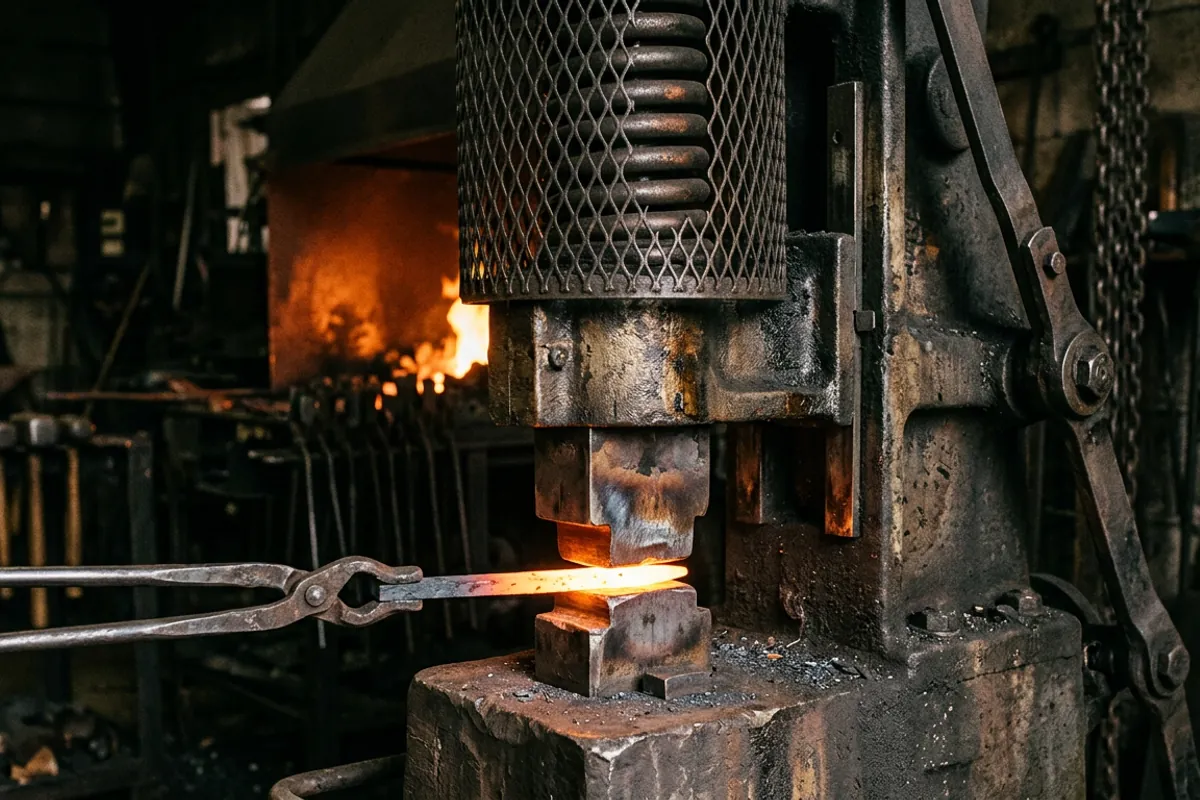
There are three families worth knowing. Mechanical hammers, like the old Little Giant, use a spring linkage and a spinning crank to throw the tup. Self contained pneumatic hammers, like the Anyang and the old Nazel and Massey machines they copy, use a motor driven piston to compress air inside the machine and slam the ram down. Utility or air hammers, like the Kinyon design, run off a separate shop air compressor. All three do the same job. They differ in how they get the ram moving and in how much fuss they are to keep running.
What none of them are is a planishing hammer. A planishing hammer smooths thin sheet, the kind of work an autobody or a sheet metal shop does, and it hits soft and fast over a small anvil. Run bar stock at forging heat under one and you will accomplish very little and probably damage the tool. Keep that distinction in your head for the rest of this guide, because the marketplace listings blur it on purpose. If you want the deeper background on this whole class of machine, I wrote it up in the blacksmith power hammer buying guide, and the pneumatic side specifically in the Anyang power hammer buying guide.
How I size a power hammer to a one person shop
Power hammers are rated by the weight of the falling ram, the tup. A "25 pound" hammer has roughly a 25 pound tup. That number is not the machine weight, which is many times larger. It is a rough index of hitting power, and for a home shop the useful range runs from about 25 pounds up to maybe 100 pounds of tup for most work.
For a one person shop forging knives, hooks, small tooling, and light architectural work, a 25 pound to 50 pound tup is plenty and often more than plenty. A 25 pound Little Giant will draw out most stock a hobby smith touches. Jump to a 100 pound tup or larger and you are into serious industrial forging, more machine than most home shops have the floor, the power, or the work to justify. Bigger is not free: a heavier hammer needs a heavier foundation, more electrical service, and a lot more room. I go through the same sizing logic for one person shops in the forging power hammer buying guide, and it holds here.
One hard rule before you shop: a power hammer wants a real foundation and a machine bolted down solid. A hammer walking across a slab is a hazard, and a spring hammer with a worn linkage can throw parts. Buy the machine with the foundation and the anchoring in your plan, not as an afterthought.
The field at a glance
Only published figures below. Tup weights and dealer prices for the Anyang models are from the Blacksmith Source listing; the marketplace planishing hammer figures are the maker's own stated specs. Where a maker does not publish a number, it reads "not published."
Scroll horizontally to see all columns.
| Machine | Type | Ram / tup weight | Blows per minute | Power tier |
|---|---|---|---|---|
| Amazon pneumatic planishing hammer | Sheet metal planisher, not a forging hammer | Not published (about 45 lb machine) | 875 to 1350 | Budget |
| Little Giant 25 lb (used) | Mechanical spring | 25 lb tup | Not published | Mid, used market |
| Anyang ST 25 kg | Self contained pneumatic | 25 kg (about 55 lb) tup | Not published | Premium |
| Anyang ST 55 kg | Self contained pneumatic | 55 kg (about 121 lb) tup | Not published | Premium |
| Tire hammer / Kinyon build | DIY mechanical or air | Builder's choice | Not published | Build cost |
The two things that jump out: the only "power hammers" you can add to a cart for a couple hundred dollars are the planishers, which are the wrong tool, and the real forging hammers all live in the used market or at four to five figure dealer prices. That gap is the whole story of shopping this category.
The self contained pneumatic: Anyang and its kind
If you are buying new and you want a forging hammer that runs off single house-type power without a separate compressor, the self contained pneumatic is the honest answer, and Anyang is the maker most North American smiths land on. Blacksmith Source lists the Anyang ST line from a 15 kg tup up through 75 kg, with the 25 kg model around 9,950 dollars and the 55 kg around 17,070 dollars as published on their site (https://blacksmithsource.com/collections/anyang-st-power-hammers). Anyang's own factory pages describe the line as self contained machines that compress air internally with a motor driven piston, "like the old Nazel, Beche, and Massey hammers," and rate the 75 kg model at 7.5 kw and about 1 kJ of blow energy (https://www.anyangforgingpress.com/anyang-power-hammer.html).
These are not cheap, and I will not pretend otherwise. What you get for the money is a machine that arrives ready to bolt down and forge, with parts and dealer support, and a resale value that holds. For a smith who forges enough to justify it, a 25 kg or 40 kg Anyang is the least fussy path to a working hammer. The tradeoff is simply the price of entry and the shipping of a very heavy crated machine.
The used mechanical: Little Giant and the American spring hammers
The classic value buy is a used American mechanical hammer, and the Little Giant is the one you will find most often. On the forums a running 25 pound Little Giant tends to change hands somewhere around 1,700 dollars, though it swings hard with condition and region. That is real forging capability for a fraction of a new pneumatic, which is why so many home shops run one.
The catch is condition. A cheap non running hammer is not a bargain if it needs everything. Owner reports on I Forge Iron and BladeForums are consistent about what to check: slop in the guides and bearings, cracks in the die dovetails, and the state of the babbit bearings, which an experienced hand can repour but which cost money and time. One buyer's math on the forums: a non running hammer around 1,200 dollars can easily need another 1,200 to 1,600 dollars to run right, landing near 3,800 dollars all in (https://www.bladeforums.com/threads/buying-a-used-power-hammer-things-to-look-for.1244793/). Sid Suedmeier's spring rebuild classes in Nebraska City come up again and again as the way people learn to bring one back.
Safety note that is not optional: multiple owners report spring failures on these hammers, springs blowing out under load, and the common recommendation is a guard or screen over the spring so a broken one cannot reach you. A worn mechanical hammer is a machine with stored energy in a spring you stand next to. Treat it that way. Eye protection to ANSI Z87.1 is the floor whenever the hammer is running, same as at the anvil or the grinder.
The build route: tire hammers and air hammers
A lot of home shop hammers are homemade, and it is a legitimate path. The three designs that come up most are the Spencer tire hammer, the Kinyon air hammer, and various helve or spring builds. A tire hammer uses a rubber tire as a clutch to throw a spring linkage; a Kinyon runs off your shop air compressor.
The honest tradeoffs from the forums: a tire hammer built at one of the weekend workshops runs around 2,500 dollars for the class plus travel, so call it 3,500 dollars all in, and the resale is poor because a homemade hammer is a hard sell. A used Little Giant, by contrast, is a known quantity you can resell (https://www.iforgeiron.com/topic/47146-50lb-little-giant-or-just-build-a-hammer/). Several experienced owners also note that once you have run a good self contained pneumatic, the mechanical and air builds feel fussier by comparison. Build one because you want the machine and enjoy the build, not because you think it is clearly the cheapest road to a running hammer. If the build itch is what you have, I collected the honest version of that decision in the DIY forge hammer writeup.
What you will actually find searching "for sale" on the marketplaces
Here is where I have to be blunt, because the search results will mislead a beginner. Type the phrase into Amazon and the listings that come back are pneumatic planishing hammers with names stuffed full of "power hammer blacksmithing." They are not forging hammers. They are sheet metal planishers rated around 50 to 100 PSI, running from about 875 to 1350 hits per minute over a small radiused anvil, built on a light stand of roughly 45 pounds. Their own spec sheets describe smoothing welds and crowning panels for autobody and fabrication. That is what they are for.
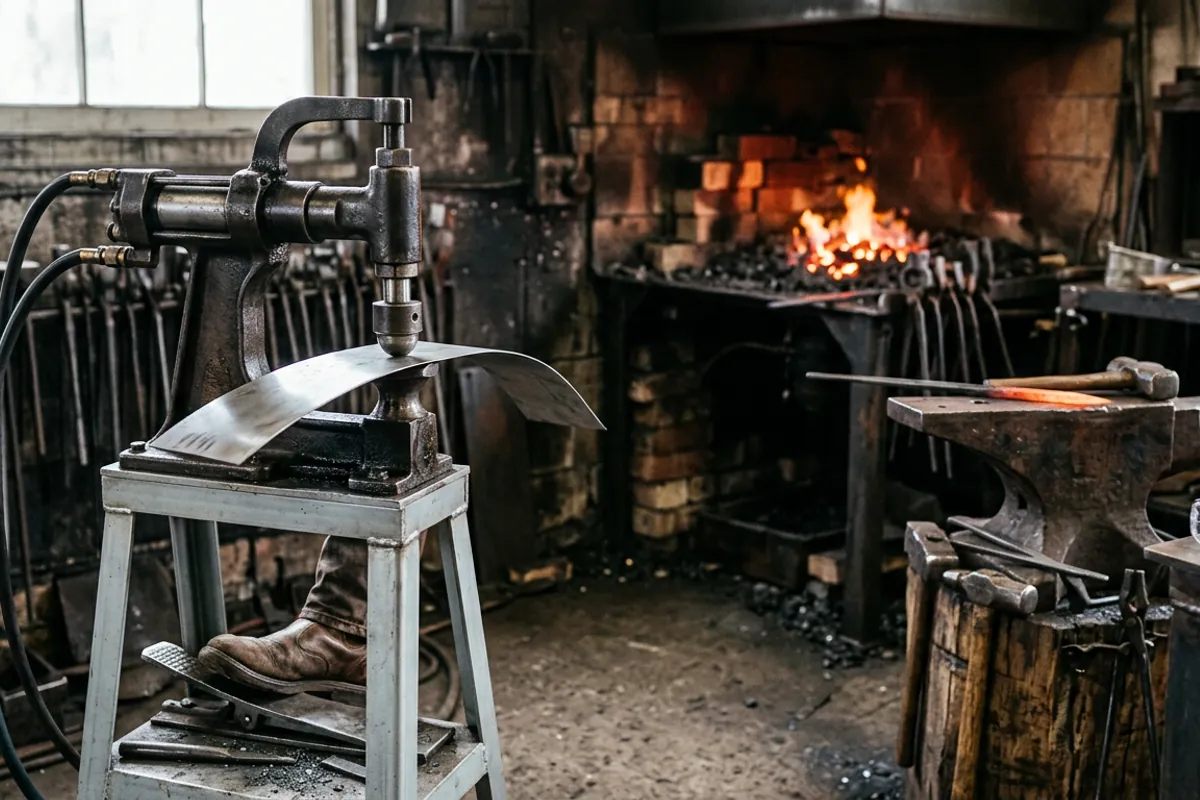
If sheet metal shaping is genuinely what you want, one of these can serve, and they are cheap. A 19.6 inch throat model on a floor stand is a common one (Check price on Amazon (paid link)), and a smaller bench style unit that ships with 1, 2, and 3 inch radius anvils is another (Check price on Amazon (paid link)). But understand what you are buying: a planisher for thin sheet, not a machine to draw out bar stock at forging heat. Feed it hot 3/4 inch square and you will be disappointed and possibly hurt the tool. I keep the marketplace price talk qualitative on purpose here; these are budget tools, and the value is only real if planishing is actually the job.
If your goal is forging, none of these belong in your shop, and no amount of keyword stuffing in the title changes that. For the hydraulic alternative to a hammer, which suits a lot of knife work better, see the blacksmith hydraulic press buying guide.
What owners say
For the forging hammers themselves I am synthesizing owner consensus, not reporting a hands on test, so here is the signal straight.
On used Little Giants, the forum consensus across BladeForums, KnifeDogs, and the rebuild communities is consistent: they are worth buying if you inspect them honestly, budget for a rebuild if the price reflects a non runner, and respect the spring hazard with a guard. The papaws wrench and Canadian Hobby Metal Workers rebuild threads walk through full teardowns and babbit pours, and the takeaway is that these are rebuildable machines with parts support, which is exactly why they hold value (https://papawswrench.com/vboard/index.php?topic=362.0).
On tire hammer versus buying, the I Forge Iron threads land on resale and simplicity. Builders love the accomplishment, but the practical crowd notes that a homemade hammer is hard to sell and a Little Giant is not (https://www.iforgeiron.com/topic/47146-50lb-little-giant-or-just-build-a-hammer/). On the self contained pneumatics, owner signal is quieter simply because fewer hobby smiths own one, but the smiths who run Anyangs generally report them as the least fussy of the bunch, which tracks with the design.
On the marketplace planishers, the owner signal from fabrication and autobody users is that they are fine light duty sheet tools at the price, and the recurring warning from smiths is the same one I am giving you: do not mistake them for forging hammers.
What I would tell a friend
If you forge enough bar stock to want a hammer and you can swing it, buy a running used 25 pound to 50 pound Little Giant with your eyes open, or a new 25 kg or 40 kg Anyang if you want new with support and no rebuild gamble. Inspect any used mechanical hard for guide slop, dovetail cracks, and bearing wear, budget for a rebuild if the price says non runner, and put a guard over that spring before you ever run it. Build a tire hammer only if the build itself is the reward.
The one to skip is the thing the search engine keeps pushing at you: the pneumatic planishing hammer sold under "blacksmith power hammer for sale." It is a sheet metal tool, not a forging machine, and buying it to forge is the most common way a beginner wastes money in this whole category. When in doubt, size to your work, bolt it down, wear your Z87.1 eye protection, and start smaller than the internet tells you to. More of the surrounding gear decisions live on the hammers and tongs hub.