content/blog/blacksmith-filing-vise-buying-guide.md already exists as a sibling; I'll write a new file. Here's the article.
Let me compose the final output.
If you are pricing a blacksmith power forging hammer for sale and starting from a keyword search, here is the short version before you spend a dime: for a one-person shop I would put an Anyang ST 55 lb (25 kg) self-contained pneumatic hammer on the floor, and I would treat the Anyang 33 lb (15 kg) as the smallest machine worth owning. And the honest part first, because it saves people real money and disappointment: you will not find a real self-contained power hammer on Amazon or at a big-box store. These are freight-shipped industrial machines that come from a handful of importers and dealers, or off the used market. Everything I write here leans on published maker and dealer specs and on what owners report on the forums, weighed against years of running hand hammers and watching these machines at club shops. It is not a bench test of every model. I have not run a 25 kg Anyang down in my own shop, and I will tell you exactly where I am reading owner consensus rather than speaking from my own bench.
What a power forging hammer actually is
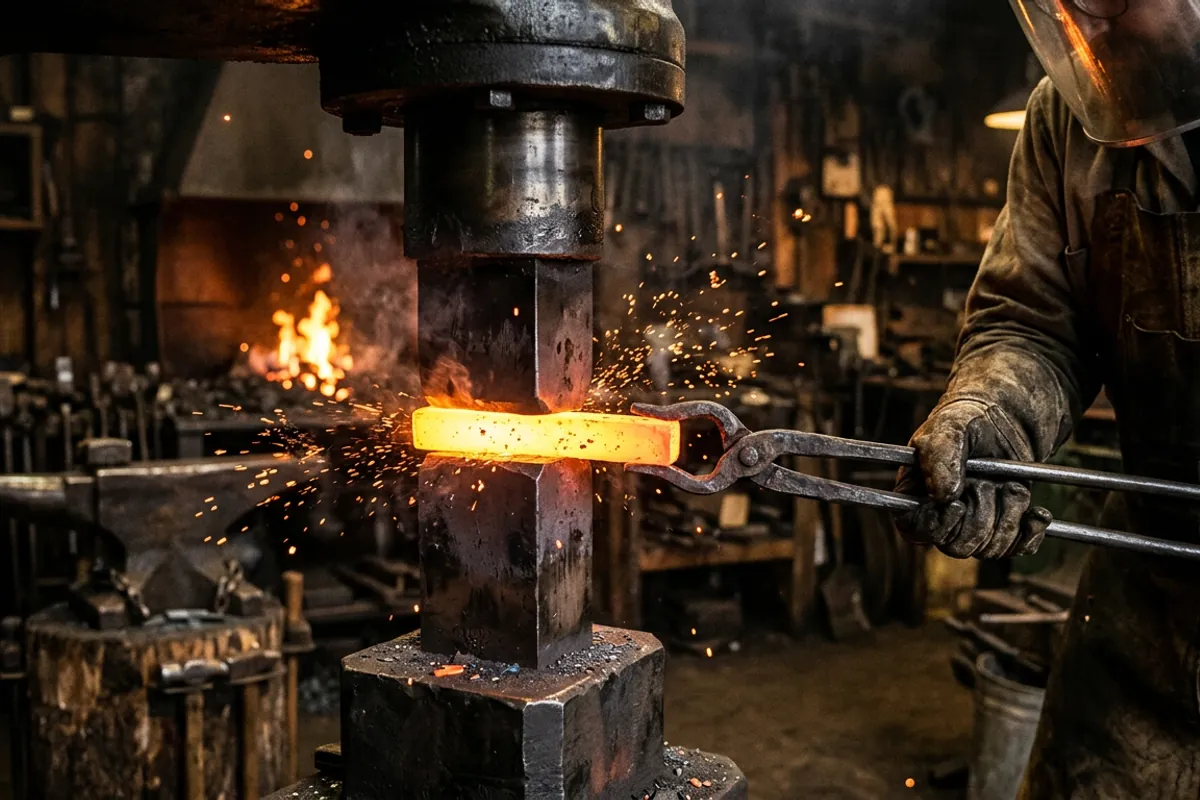
A power forging hammer is a machine that lifts a heavy ram and drives it down onto your work so you are not swinging a sledge all day. You hold the hot steel on the lower die with tongs, work a treadle or pedal with your foot, and the hammer does the pounding. It is the single tool that turns a one-person shop into something that can move real stock, draw out thick bar, and forge blades or hardware without a striker standing across the anvil from you.
The kind most home and small pro shops buy today is a self-contained air hammer. The motor spins a piston that compresses air inside the machine itself, and that air drives the ram. There is no separate shop compressor, no high-pressure hose running across the floor. The old Little Giant and other mechanical hammers used a spring and a crank instead of air, and a lot of those are still working after a hundred years. Both kinds do the same job: they replace the muscle, not the skill. You still have to know where to put the steel and when to pull it.
If you want the ground-level explanation of the whole category before you shop, I wrote it up in the power forging hammer guide, and the hammers and tongs topic hub collects the rest of the striking-tool guides in one place.
The honest truth about "for sale" and where you actually buy one
Type "blacksmith power forging hammer for sale" into a search bar and you will get three very different things mixed together: real machines from dealers, factory-direct listings on trade sites like Alibaba, and a pile of hand hammers that are not power hammers at all. Sort them out before you get excited about a price.
Real self-contained hammers in the US come mostly from a few sources: Anyang importers such as Anyang USA and Blacksmith Source Tool Company, Say-Mak dealers, and smaller makers. New, a small Anyang runs into the thousands. Blacksmith Source lists the 25 kg at 9,950 dollars for the three-phase model and 10,950 dollars for the single-phase version with a VFD (https://blacksmithsource.com/products/anyang-st-25-kg-pneumatic-power-hammer). That is the real world of new-machine pricing, and it is why the used market matters so much.
The factory-direct listings you see on trade sites are the same machines before an importer has set them up, backed them, and stood behind the warranty. Buying one of those and eating the freight, the rigging, and any support problem yourself is a project, not a shortcut. For a first hammer I would buy through a US dealer who will answer the phone when the valving acts up.
And the used market is where a lot of good hammers change hands. A sound Little Giant, a Beaudry, or an older self-contained hammer can be a better buy than a cheap new import, if you know what you are looking at. That is a whole skill of its own, the same way buying an anvil is. If you have shopped antique anvils for sale you already know the drill: bring cash, bring a flashlight, and walk away from anything with a cracked frame no matter how cheap it is.
How the sizes compare
Here are the published specs for the two Anyang sizes I would actually consider for a home shop, from the maker and the US dealer. Only figures they publish are in the table; where a number is not stated I say so rather than guess.
Scroll horizontally to see all columns.
| Model | Ram weight | Blows per minute | Die face / max stock | Machine weight | Motor |
|---|---|---|---|---|---|
| Anyang ST 15 kg | 33 lb / 15 kg | 300 | 70 x 50 mm die face | 540 kg | 2.2 kW, single phase |
| Anyang ST 25 kg | 55 lb / 25 kg | 250 | up to 40 x 40 mm square or 45 mm round | 1100 kg | 3 kW, three phase |
Sources: Anyang ST 15 kg page (https://anyangst.com/15kg-hammer/) and Blacksmith Source Anyang ST 25 kg page (https://blacksmithsource.com/products/anyang-st-25-kg-pneumatic-power-hammer).
Two things to read out of that table. First, ram weight is the headline number, but the machine weight tells you what the hammer can really do, because a heavy frame resists the blow instead of walking across your floor. The jump from a 540 kg machine to an 1100 kg machine is a bigger deal than the ram numbers alone suggest. Second, the motor phase matters for a home shop: the 33 lb runs on single-phase power, and the 55 kg is three-phase unless you buy the VFD version. If you are on a normal residential service, that VFD line item is not optional, it is part of the price.
Anyang ST 33 lb, the smallest I would bother with
The 33 lb (15 kg) Anyang is the entry point into real self-contained hammers, and it is a genuine machine, not a toy. It swings a 33 lb ram at 300 blows per minute, runs on single-phase power, and weighs 540 kg, per Anyang's own spec page (https://anyangst.com/15kg-hammer/). For knives, small tooling, and light hardware it is plenty, and the single-phase motor makes it the easy one to actually wire into a home shop.
The tradeoff is reach. A 33 lb hammer will draw out light stock happily but it will get tired under heavy bar, and if you grow into axes, big blades, or thick industrial work you will wish you had gone bigger. The common advice on the forums, and it matches what I have watched at club shops, is that people rarely regret buying one size up and often regret buying one size down. So the 33 lb is the machine I would point a knifemaker or a light-hardware shop toward, and the one I would tell a general blacksmith to skip in favor of the 55 lb if the budget and the electrical service can stretch.
Anyang ST 55 lb, the one I would buy for a one-person shop
The 55 lb (25 kg) is the size I would put in my own shop if I were buying new. Blacksmith Source publishes it at 250 blows per minute, forging up to 40 x 40 mm square or 45 mm round stock, on a 3 kW motor, with the whole machine tipping the scale at 1100 kg (https://blacksmithsource.com/products/anyang-st-25-kg-pneumatic-power-hammer). That mass is the point. It is enough hammer to draw out heavy bar, forge weld under power, and still finish delicate work with a soft treadle, and enough frame that it stays put while doing it.
The honest cost of that capability is the three-phase motor and the price. At close to 10,000 dollars new, and more with the single-phase VFD, this is a serious purchase. It is also the machine that stops being the limiting factor in your shop, which the 33 lb sometimes is. If I could only own one new power hammer and I did general smithing rather than only knives, this is the one, no hesitation. If you want the deeper size-by-size breakdown of the whole Anyang line, I put it in the Anyang power hammer buying guide.
The used market, Little Giant and mechanical hammers
Before you finance a new import, look hard at used mechanical hammers. A Little Giant in the common 25 lb and 50 lb sizes is a proven machine, parts and rebuild knowledge are widely available, and a well-kept one will outlast its owner. The catch is that a tired one needs work: worn dies, a slapping toggle linkage, or a cracked frame can turn a bargain into a project. The forum consensus, and it is worth taking seriously, is that a mechanical hammer in good tune is a joy and one out of tune is a headache, so buy on condition, not on price.
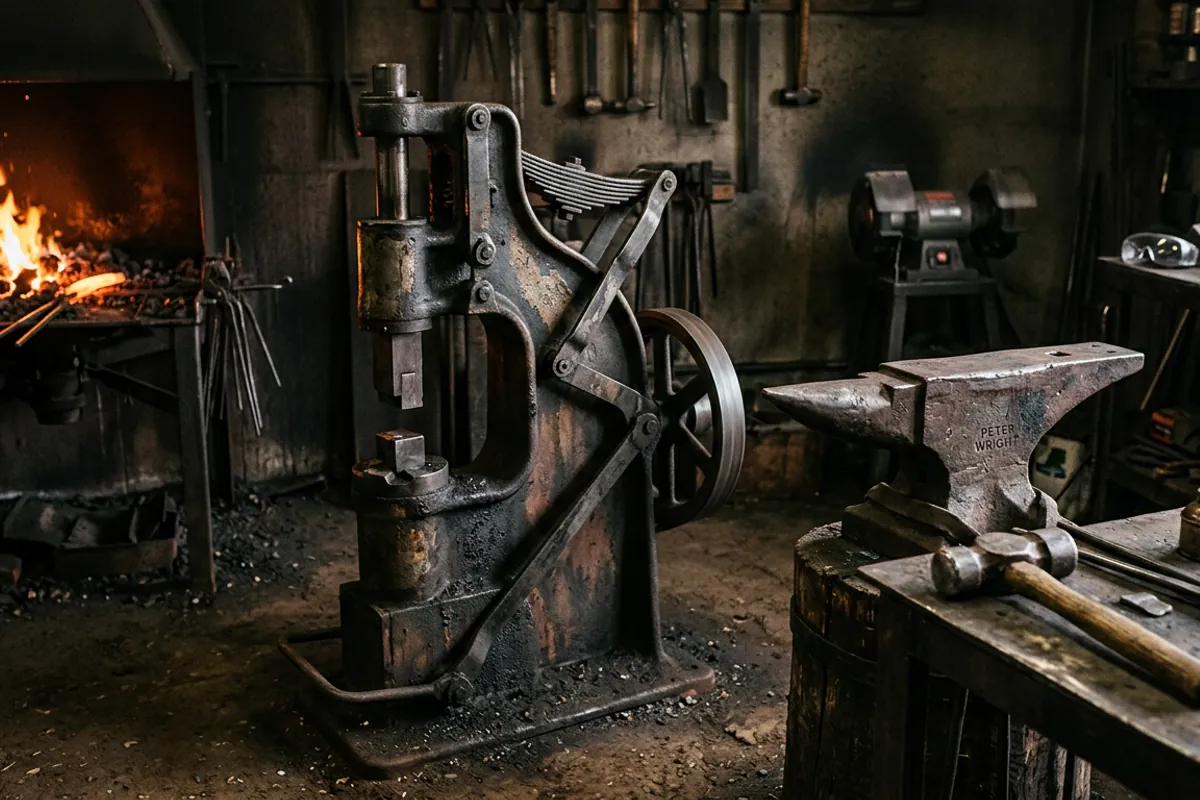
What I would not do is buy a heavy old hammer sight unseen the way people buy heavy old anvils and hope for the best. A cracked frame is not a fixable flaw, it is the end of the machine. Look it over running if you possibly can, listen for a clean blow rather than a rattle, and check the dies and the frame the way you would check the face and heel of an antique anvil worth buying. If you cannot see it run, price it as a rebuild and no more.
If a power hammer is out of budget, the hand hammer that moves metal
Most people searching for a power hammer are not ready to spend five figures, and that is fine. A power hammer replaces a striker, it does not replace the everyday hammer in your hand, and a good hand hammer will teach you more about moving steel than any machine. If the power hammer is a next-year purchase, put the money into a hammer you will actually swing every session.
For general forging, a rounding hammer around 2 lb is a hammer I would hand almost any smith. The Nordic Forge 2 Lb. rounding hammer (paid link) is a straightforward, honest example of the pattern: one flat face, one rounded face for moving metal fast. If you want more head weight for drawing out heavier stock and you do not mind dressing the faces yourself, a heavier forged hammer like the Blacksmith 3 lb handmade forge hammer (paid link) gives you more mass per blow. Neither one is fancy, and that is the point: a plain hammer you swing every day beats a machine you are still saving for. When you do move up to power, the hand hammer stays on the rack for the fine work. For the full rundown on choosing a striking hammer, I keep the cross pein hammer guide up to date.
One safety note that is not optional whichever hammer you swing: wear eye protection rated to ANSI Z87.1. Hot scale flakes off forged steel and flies, and a hammer face can chip. I have a scar in my memory from a quench-oil flare-up that took my eyebrows early on, and it made me a stickler about this. Glasses on before the steel comes out of the fire, every time.
What owners say
For the machines Grady has not run down himself, here is what the forums actually report, attributed so you can read it yourself.
On the Anyang hammers, owner signal is broadly positive on value. The BladeForums "Anyang hammer owners" thread collects real owners talking about setup, dies, and daily use, and the general read is that they are solid working machines for the money once dialed in. On I Forge Iron, the recurring beginner question is whether to buy a small Anyang or build a homebrew tire hammer, and the honest answer that comes back is that the Anyang is a finished, backed machine while a self-built hammer is a project you have to see through.
On the premium end, the consensus is that the Say-Mak is the machine people lust after, described in one forum discussion as "the Cadillac of hammers," while some owners specifically prefer self-contained designs over anything needing a separate compressor. A minority who have run several air hammers report being steered off a particular Anyang by its valving after a session on one, which is a fair reminder that these machines have quirks and that buying through a dealer who supports the valving matters. That is owner consensus, not my own bench, and where the signal is mixed I am telling you it is mixed rather than smoothing it over.
If you are weighing a hammer against a press for your shop, the tradeoffs are real and I laid them out in the hydraulic press buying guide; a press squeezes where a hammer strikes, and the two do different work.
What I would tell a friend
Buy the biggest self-contained hammer your budget and your electrical service can carry, because nobody regrets the extra mass and plenty of people regret buying small. New, that means the Anyang 55 lb (25 kg) for a general one-person shop and the 33 lb (15 kg) if you are strictly on knives and light work. Used, a sound Little Giant is a genuinely good buy, but only if you can see it run or you price it as a rebuild. Skip the factory-direct trade-site listings for a first hammer; the dealer support is worth what it costs.
And do not let the machine hunt stall your forging. A power hammer is a force multiplier for skill you build with a hand hammer, so if the five-figure machine is not this year's purchase, buy a good hammer, wear your Z87.1 glasses, and put in the reps. The hammer skills carry straight over the day the big machine finally lands on your floor.