The best antique anvils for sale are the boring ones: a 100 to 200 pound wrought-body anvil with a hard steel face still fully attached, sold by somebody who does not know or care what a Peter Wright is. That is the whole game. My own anvil, Bessie, is a 148 pound Trenton I have put more hours on than every other tool in the shop combined, and she cost me less than a night out because the face was dirty and the seller thought dirty meant worn out. So this guide is about how to tell the difference before you hand over cash, which brands are worth chasing, and which new anvils I would buy instead when the antique market gets stupid in your area.
Two honesty notes before we start. I am a hobby smith of about twenty-five years, not a dealer and not an appraiser, and I have not owned every maker below. Where I am reporting what the wider community sees, I say so and link the thread. The new-anvil picks lean on published specs and owner reports weighed against shop experience, not on bench tests I did not run.
The short version
Buy an antique anvil with a sound face and mediocre cosmetics. Skip the pretty one with a face that rings dead or thuds, no matter how crisp the maker's mark is. In wrought-body anvils with a forge-welded steel top plate, the plate is the anvil: everything under it is just mass. If that plate is separating, cracked, or ground down to nothing, you are buying a heavy paperweight with good provenance.
The three things I check, in order: rebound off the face, whether a straightedge shows sway or a dish, and whether the edges of the steel plate look like they are still bonded along their whole length. Everything else, including rust, a chipped horn tip, a mushroomed heel, and a hundred years of hammer dings, is cosmetic or fixable and should be knocking money off the price rather than off your list.
If you would rather not gamble on a used tool at all, that is a legitimate choice, and the new-anvil section near the bottom covers what I would put in a shop instead. For the wider decision about weight and pattern, my anvil weight guide and the rest of the anvils topic hub go deeper than I can here.
What the antique makers actually are
Antique anvils sort into three construction families, and the family matters more than the name stamped on the side. Wrought iron body with a forge-welded high carbon steel face is the classic English and American pattern. Cast steel is one piece all the way through. Cast iron body with a steel plate is the budget construction of its own era, and cast iron with no plate at all is not an anvil, it is a doorstop with a horn.
Nobody published a hardness figure for these tools when they were made, and anybody quoting you an HRC number for a hundred-year-old anvil is guessing. So the table below gives era and construction, which are documented in collector references, and says "not published" where a number would be invented.
Scroll horizontally to see all columns.
| Maker family | Era, per collector references | Construction | Weights commonly offered | Published hardness |
|---|---|---|---|---|
| Peter Wright (Dudley, England) | Mid 1800s into the early 1900s | Wrought body, forge welded steel face | 70 to 300 pounds and up | Not published |
| Hay-Budden (Brooklyn, New York) | Roughly 1892 to 1926 | Wrought body, forge welded steel face; later ones two-piece | 80 to 300 pounds | Not published |
| Trenton (Columbus Forge and Iron, Ohio) | Late 1800s into the mid 1900s | Wrought body, forge welded steel face | 100 to 300 pounds | Not published |
| Arm and Hammer (Columbus Forge and Iron) | Same era as Trenton | Wrought body, forge welded steel face | 100 to 250 pounds | Not published |
| Mousehole Forge (Sheffield) | 1700s into the early 1900s | Wrought body, forge welded steel face | 90 to 200 pounds | Not published |
| Fisher and Norris (Trenton, New Jersey) | Roughly 1854 to 1970 | Cast iron body, thermite welded tool steel face | 70 to 400 pounds | Not published |
| Vulcan (Illinois Iron and Bolt) | Early to mid 1900s | Cast iron body, thinner steel plate | 50 to 200 pounds | Not published |
The Fisher deserves its own note because new smiths pass on them for the wrong reason. Fisher and Norris built a cast iron body with a real tool steel face welded on, and collector references credit them as the first and last major American anvil maker, in business from about 1854 to 1970, with the eagle logo usually on the front foot (maker marks reference). A Fisher does not ring. That silence is the reason they get called dead, and it is also the reason people who work in attached garages hunt for them. A quiet anvil with good rebound is a gift, not a defect. Vulcans are the ones to be careful with: same general idea, thinner plate, sold as the low-end catalog anvil for farms and school shops, and once that thin plate is gone there is nothing left to work on.
The inspection kit I would buy before the anvil
This is the part people skip, and it is the cheapest insurance in the hobby. Four items, all of which live in a bucket in my truck, all of which cost a rounding error next to a two hundred dollar anvil you cannot use.
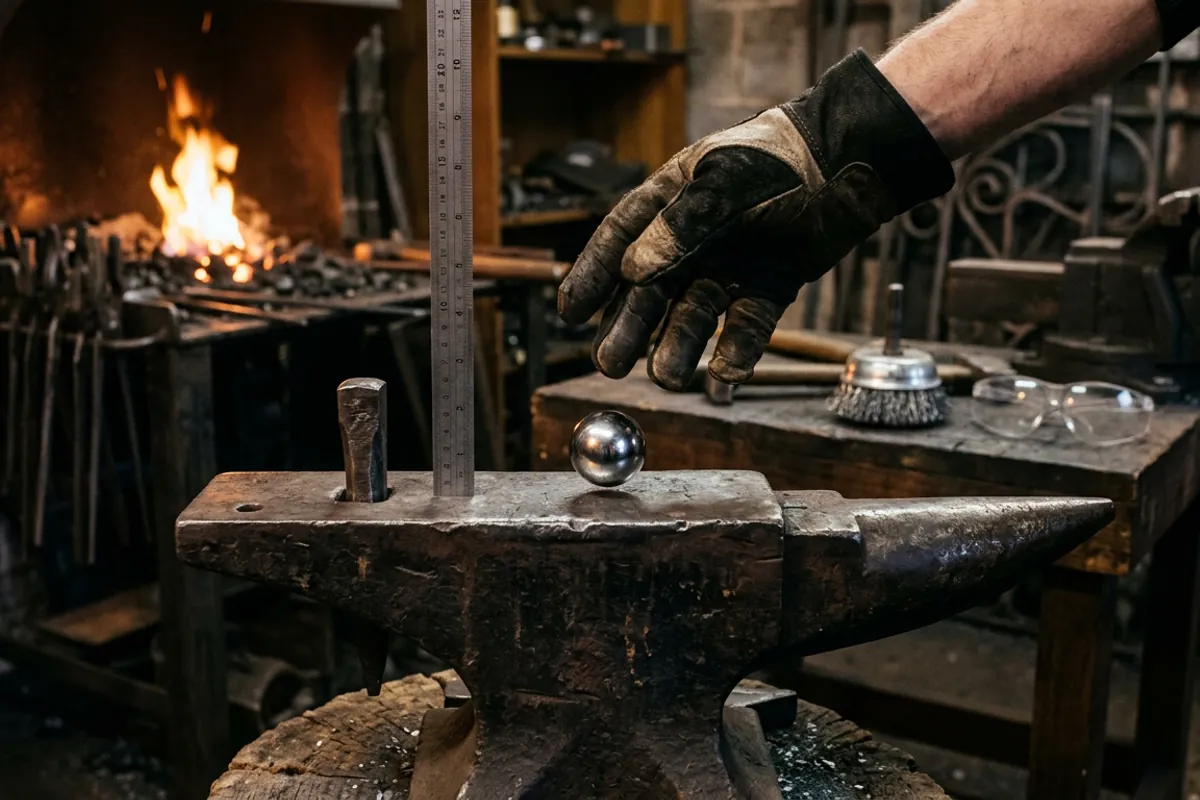
A one inch chrome steel ball bearing is the whole rebound test. Buy two, because you will drop one in the gravel at a farm auction and never see it again. Check price on Amazon (paid link)
A 24 inch precision straightedge tells you in five seconds what your eye cannot: whether the face is flat, swaybacked in the middle, or dished where a farrier hammered the same spot for forty years. Hold it on edge across and along the face and look for light underneath. Check price on Amazon (paid link)
A knotted wire cup brush for an angle grinder gets a century of rust and paint off the face so you can actually see the weld line of the top plate and any cracks in it. A knotted 4 inch cup in carbon steel is the standard shop choice. Check price on Amazon (paid link)
Eye protection rated to ANSI Z87.1, worn every second that wire cup is spinning. A knotted cup brush throws individual wires at speed, and they go in and stay in. I do not treat PPE as optional, and the reason is not theoretical: early on I quenched a blade in oil that was too cold, standing too close in a cotton shirt with no face shield, and the flare took my eyebrows. I kept my eyesight by luck, which is not a safety system. Get glasses that meet the standard and, for the wire wheel, a face shield over them. Check price on Amazon (paid link)
If you want the fuller rundown of what protects you in a smithy and what is just marketing, that is in my blacksmith safety gear guide.
How to run the rebound test on somebody else's anvil
Ask permission first, then hold the ball bearing exactly ten inches above the face, over the middle of the plate, and let it fall. Do not throw it. Watch how high it comes back against the ruler you are holding beside it. anvilfire's rebound article puts a really hard anvil face at 75 to 90 percent of the drop height, and notes that the test is really a measure of how much of your hammer energy goes into the work instead of into the anvil (anvilfire, testing rebound and hardness). Smiths in the long-running rebound test thread on I Forge Iron generally land in the same place and warn that eyeballed numbers run optimistic, so measure against a rule rather than trusting your impression.
Test in three or four places: center of the face, over the waist, near the heel, and out toward the horn end. A face that rebounds well in the middle and goes soft at the heel usually means the plate is thin or delaminating there, which shows up later as a section that dents instead of moving your steel. Then set a hammer head on the face and let it drop from a few inches. On a good anvil it hops back and keeps hopping in smaller bounces. On cast iron it lands with a thud and mostly stays put.
While you are there, tap along the outer inch of the plate with a small hammer and listen. A consistent tone all the way around says the weld is intact. A flat, buzzy patch in one area is the sound of a plate that is no longer stuck down, and it is the single most common reason I tell people to walk away.
The condition problems that are fine, and the ones that end the deal
Fine: surface rust, paint, a rounded-off horn tip, dinged and radiused edges, a chipped corner or two, and a face that is not mirror smooth. All of that either cleans up or simply does not matter. Radiused edges are what you want anyway. A slightly dished face is workable for most of what a hobby smith does, and I would rather have a soft-looking face with real rebound than a ground-flat face that somebody surfaced by removing half the plate.
Deal enders: a plate separating from the body, a crack running across the face or down into the waist, sway deeper than a hard-to-ignore gap under your straightedge, a face milled or ground so thin that the weld line is at the working surface, and dead rebound anywhere across the middle third. Also treat a repair-welded face as a hard no unless the price is scrap value. Building a face back up correctly is skilled work, and a bad job leaves you with hard, brittle beads that chip into your workpiece.
And resist the urge to fix a good antique. The most common damage I see on old anvils is not a century of blacksmithing, it is a new owner with a grinder and a plan. Clean the face, knock down anything that would print on your work, and forge on it. My longer write-up on which old anvils are worth the money, model by model, is in the antique anvils buying guide.
What antique anvils for sale actually cost
There is no national price. Anvil prices are regional and they moved hard after forging shows put blacksmithing on television. Smiths tracking this in the anvil price per pound thread on I Forge Iron report a spread from under a dollar a pound in farm country up past ten dollars a pound for a top-shelf anvil in a metro area, with condition and rebound driving the premium. The long-running anvil prices thread on The Garage Journal reads the same way: people who watch estate sales patiently still find fair deals, and people shopping online listings pay retail plus freight.
Two practical rules. First, price per pound only makes sense next to rebound: a 200 pound anvil with a delaminating plate is more expensive at fifty dollars than a sound 120 pound anvil at four dollars a pound. Second, shipping eats deals alive. A 150 pound cast lump costs real money to freight, and buyers on the forums routinely report paying more in shipping than the anvil was worth. Local pickup, cash, and a hand truck is how these tools change hands.
Where to look
Farm auctions and estate sales are still the best odds, because the anvil is one lot among two hundred and the crowd is there for tractors. Local classifieds work if you can move fast and are willing to drive. Blacksmithing club meetings and regional conferences are the underrated option: club members sell to club members at sane prices, and somebody there will happily walk over and inspect the thing with you.
Online auction listings are the worst value and the highest risk, because the two things you most need to do, drop a ball bearing on the face and put a straightedge across it, are exactly what you cannot do through a photograph. If you buy sight unseen, ask the seller for a video of a one inch bearing dropped from ten inches and for a photo with a straightedge on the face. A seller who will not do that is telling you something. My general checklist for evaluating any anvil, old or new, is in what to look for in an anvil for sale.
The new anvils I would buy instead
Sometimes the antique market in your area is just broken. If the only old anvils for sale near you are overpriced Vulcans with worn plates, buying new is the rational move, and it is a better first anvil than a bad antique. Published specs, cited:
Scroll horizontally to see all columns.
| Anvil | Weight | Material as published | Face size | Published hardness | Price tier |
|---|---|---|---|---|---|
| Kanca drop forged bladesmith anvil | 77 pounds (35 kg) | Drop forged C45 carbon steel | 13.25 x 3.74 in | 54 to 62 HRC (Centaur Forge) | Mid |
| VEVOR single horn anvil | 66 pounds (30 kg) | Cast steel | 10.35 x 3.46 in | 50 HRC claimed (VEVOR) | Budget |
| VEVOR single horn anvil | 132 pounds (60 kg) | Described inconsistently across its own listings | Face not published; base 10 x 7.3 in | 50 HRC claimed (VEVOR) | Budget |
The Kanca is the one I would point a friend at if the budget stretches, because drop forged C45 with a published 54 to 62 HRC face is a real anvil by construction, not by adjective. The VEVOR anvils are the budget end and honest about what they are once you read the specs rather than the headline: a 50 HRC face is softer than a good antique plate, which is why they mark up faster under a hard hammer.

The 66 pound is a small anvil. It will teach you to forge, it will move quarter inch stock, and it will feel light under heavy work. If you can afford the jump, more mass is the upgrade that matters most.

At 132 pounds you are in the weight class where a hobby shop stops fighting the tool. Note the honesty problem in VEVOR's own listings: the 132 pound anvil is described as cast steel on one page and cast iron on another, and the face dimensions are not published anywhere I could find. I own neither, so treat that as a specs-and-owner-reports read, not a test. I go through this line in more detail in the VEVOR anvil guide, and the wider new-anvil field is in best anvils for beginners.
What owners say
On antique makers, the consensus across forums is remarkably consistent: buy on rebound, not on name. Threads on Practical Machinist about Peter Wright anvils and Fisher anvils circle the same points, that a well-preserved wrought-body anvil with an intact plate is still the standard against which people measure new production, and that condition swamps maker in both value and usability.
On Fishers specifically, owners in the Fisher 1893 thread on KnifeDogs describe exactly the tradeoff I would expect: no ring, good working feel, and a tool that is pleasant to work next to. Ask ten smiths about a quiet anvil and about half will tell you it is the best thing about it.
On the ball bearing test itself, the thoughts on rebound thread at I Forge Iron is worth reading before you use a percentage as a hard pass or fail. The complaint there is that people over-read small differences, compare across different ball sizes and drop heights, and reject usable anvils over ten points of rebound. Consistency across the face matters more than the exact number.
On prices, the owner signal is loud and unhappy: the Garage Journal price threads are full of people who watched a local anvil sell for triple what it went for a decade earlier. That is not a reason to overpay, it is a reason to be patient and to keep the new-anvil option on the table.
What I would tell a friend
Chase a wrought-body anvil in the 100 to 200 pound range from any of the known makers, judge it with a ball bearing and a straightedge rather than with the maker's mark, and pay attention to whether the steel plate is still fully bonded, because that plate is the tool. Walk away from dead rebound, from cracks, from a plate ground thin, and from any face somebody has already welded on. Do not buy sight unseen unless you have seen a rebound video, and do not pay freight on a gamble.
If nothing sound is available near you at a sane price, buy new mass instead of a worn antique. The Kanca is the better tool on published specs; the VEVOR is the budget entry and behaves like one.
And the safety note that matters most here has nothing to do with buying: the first thing you will want to do with a rusty old anvil is put a wire cup on a grinder and clean it up. Wear eye protection that meets ANSI Z87.1 with a face shield over it, keep natural fibers on your arms, and stand out of the line of fire. Wire wheels shed wires, and mine took a few years off my nerves before I learned that.