If you have been scrolling listings with "anvil for sale" in the title, here is the short answer before the long one: the best money you can spend is usually on a used American pattern anvil bought at a fair price per pound, and if you want new steel with a warranty behind it, I would put the NC Tool 70 lb Big Face in a home shop before any of the import castings. If your budget is a couple hundred dollars, buy a cast steel import and not a cast iron one. That single distinction, steel versus iron, matters more than brand, shape, or looks.
I need to be straight about what this guide is. I have run one anvil hard for most of twenty-five years, a 148 lb Trenton I call Bessie, and she is the yardstick I measure everything against. I have not bought and beaten on every anvil below, so what follows is published specs from the makers and non marketplace retailers, plus what owners report on the forums, weighed against what I know about how an anvil behaves under a hammer. Where the signal is thin, I say so. Nothing here is a bench test I did not do.
What you are actually shopping for
An anvil is a mass of hard material that sends your hammer energy back into the hot steel instead of swallowing it. Everything else is detail. Three things decide whether a listing is worth your money.
Material first. Cast steel or forged steel with a hardened face returns energy. Cast iron does not, cannot be hardened into a useful face, and dents under a hammer. Plenty of the cheapest listings are cast iron, and some sellers are vague about it on purpose.
Mass second. More weight under the hammer means more of your blow goes into the work. For general hobby forging I tell people 100 to 150 pounds is the comfortable zone, and 70 pounds is a workable floor if it is bolted down solid. I laid out the reasoning in what size anvil do you actually need, so I will not repeat all of it here.
Price third, and it is the one people get wrong. Brown County Forge's anvil cost writeup gives a rule I have used for years when helping students shop: pay $7 per pound or less. Good used anvils in the upper Midwest still trade below that if you are patient. Above it, you are paying collector money for a working tool, and the smiths on the I Forge Iron anvil price per pound thread have watched that number drift for years.
How the field compares
Published figures only. Where a maker or retailer does not state a number, it says not published, because guessing at a hardness figure for you would be worse than useless.
Scroll horizontally to see all columns.
| Anvil | Weight | Material | Face or work surface | Hardness | Price tier |
|---|---|---|---|---|---|
| NC Tool Big Face | 70 lb | Ductile iron casting, milled | 3.75 x 6 in face, 3.5 x 8 in horn | Not published | Premium |
| SmarketBuy single horn | 66 lb | Steel casting | 5.9 x 4.33 in top, 21 in overall length | Not published | Budget |
| VEVOR single horn | 66 lb | Cast steel | 10.35 x 3.46 in tabletop | 55 HRC claimed, 50 HRC on the Lowe's listing | Budget |
| VEVOR single horn | 132 lb | Cast steel | Not published | 55 HRC claimed | Budget |
| Doyle 65 lb | 65 lb | Cast steel | 50 sq in face | 63 HRC in a comparison table, up to 80 percent rebound claimed | Budget |
| Grizzly G8147 | 55 lb | Cast iron | 3.875 x 8.625 in face | Not published | Skip |
Sources: Professional Farrier Supply's NC 70 lb Big Face spec sheet, Centaur Forge on NC Tool anvil material, VEVOR's 66 lb product page, VEVOR's 132 lb product page, Harbor Freight's Doyle 65 lb listing, and Grizzly's own G8147 page.
Notice how many hardness cells say not published. That is the state of this market. Harbor Freight is the nearest thing to an exception, and even there the 63 HRC figure sits in a competitor comparison table rather than the product spec list, while "up to 80 percent" rebound is still doing a lot of work. Everyone else leaves the number off, which tells you something on its own.
NC Tool Big Face 70 lb: the new anvil I would buy
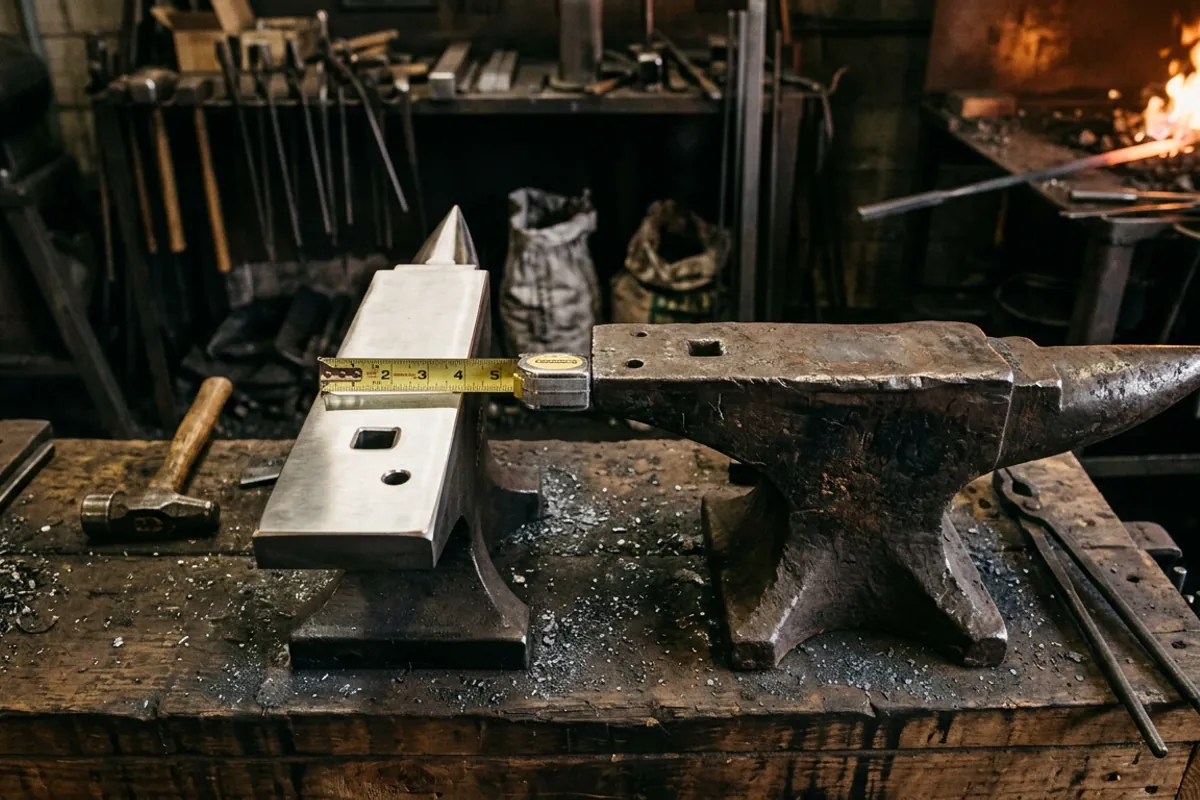
This is a farrier anvil that blacksmiths have quietly used for decades. Professional Farrier Supply publishes the geometry: 70 lb, a 3.75 x 6 in face, a 3.5 x 8 in horn with a 1 in hardy hole, 8.75 in tall, on an 11 x 9 in base. Centaur Forge states plainly that NC anvils are made from ductile iron, cast and poured, which is not the same animal as the gray cast iron in a hardware store doorstop. Ductile iron castings, milled and treated, have been doing farrier work under real hammers for a long time.
What makes it worth the premium is the face. It is wide for the weight, flat, and milled, and the hardy hole is a full inch, which means standard hardy tooling fits without shimming. The thin heel is a farrier feature, useful for shoe work, and it is the part I would be gentlest with. Do not use the heel as an anvil for heavy drawing.
The honest tradeoffs: 70 lb is light. Bolt it down or mount it on a solid stump or a filled stand, or it will walk and eat your energy. NC does not publish a face hardness, so if you buy one, run the rebound check I describe below and know what you have. And it is not cheap. The 70 lb Big Face sits in premium territory next to a $200 import.
Check price on Amazon (paid link)
SmarketBuy 66 lb cast steel: the budget bench anvil
This is the shape you see in a hundred listings, a single horn London style import in steel. The seller publishes overall dimensions of about 21 x 6 x 6.18 in, a top of 5.9 x 4.33 in, a 7 in round horn, a flat horn of about 8 in, and hardy and round holes at roughly 0.79 in each. Face hardness is not published anywhere I could find, which is the standard weak spot with import castings.
Who it suits: someone who wants to start forging this month, has a hammer and a forge, and does not have a used anvil within driving distance. Sixty six pounds of steel with a decent face will make hooks, bottle openers, tongs, and small blades all day. It will not do what Bessie does when I am moving heavy stock, and you will feel that difference the first time you try to draw out an inch of square.
Two practical notes. The 0.79 in hardy hole is smaller than the 1 in standard, so budget hardy tooling around that or plan to make your own shanks. And the imports usually arrive with paint on the face and sometimes with a slightly convex or wavy surface. A little work with a flap disc and a sanding block gets it flat. Wear ANSI Z87.1 rated eye protection at the grinder, not shop glasses that look about right.
Check price on Amazon (paid link)
VEVOR 66 lb and 132 lb: cheap weight, honest limits
VEVOR sells the same general casting in several weights, and the price per pound is the lowest in this guide. The 66 lb listing publishes a 10.35 x 3.46 in tabletop with 0.7 in hardy and round holes, and the maker claims 55 HRC. Lowe's lists the identical anvil at 50 HRC. I mention that because it tells you exactly how much confidence to place in a spec number from a company that also markets a 132 lb anvil as "cast iron" in one listing and "cast steel" in another. Those cannot both be right, and you should assume the listing text was written by marketing, not by metallurgy.

If you are going to buy in this class, buy the weight. A 132 lb anvil at import prices is a far better use of the same dollars than a 66 lb one, because the one thing these castings do reliably is be heavy, and mass under the hammer is real regardless of whose name is on the side.

What I would not do is expect edge retention. Owners generally report acceptable rebound and a face that dings when you miss and catch an edge. Treat the far edge as a working radius, break the sharp corners yourself with a file, and it will serve. If you want the reasoning on which class of anvil suits a first shop, the beginner anvil roundup covers it in more depth.
Doyle 65 lb: the cast steel one you buy in person
Harbor Freight's Doyle 65 lb is published as cast steel with a 50 sq in face, 3/4 in hardy and pritchel holes, and a claim of up to 80 percent rebound, with a lifetime warranty against defects on units bought on or after 5/19/25. It is not an Amazon item, so there is no affiliate link here and I have no reason to push it either way.
The reason I include it is that it is the only anvil in this guide you can put your hands on before paying. You can bring a ball bearing to the store, drop it on the face, and buy the good one off the shelf. That is worth more than any spec sheet. The forum reaction when the cast steel version appeared, in the I Forge Iron thread so Harbor Freight says they have a cast steel anvil now, was cautious interest rather than the flat dismissal the old cast iron units always got. That shift is the useful signal.
Cast iron anvils, and why I skip them
Grizzly publishes the G8147 honestly: 55 lb, cast iron, with a 3.875 x 8.625 in face and a 7/8 in hardy hole. Grizzly is not hiding anything. The problem is the material, not the company.
Gray cast iron cannot be hardened into a working anvil face. Hot steel hammered on it will leave marks in the anvil rather than the anvil shaping the steel, and the energy that should bounce back at you dies in the casting. In the long running I Forge Iron thread on Harbor Freight anvils the recurring owner complaint about cast iron units is exactly that: the face deforms, and your arm goes dead because nothing comes back. Smiths there consistently describe a cheap steel anvil with a hardened top as bouncing the hammer where the iron one thuds.
Cast iron anvils are fine as bench blocks for cold riveting, straightening, and light sheet work. As forging anvils they waste your effort. If the listing does not say steel, assume iron and price it as a doorstop.
How to inspect an anvil before money changes hands
This is the part that saves you the most money, especially on a used find.
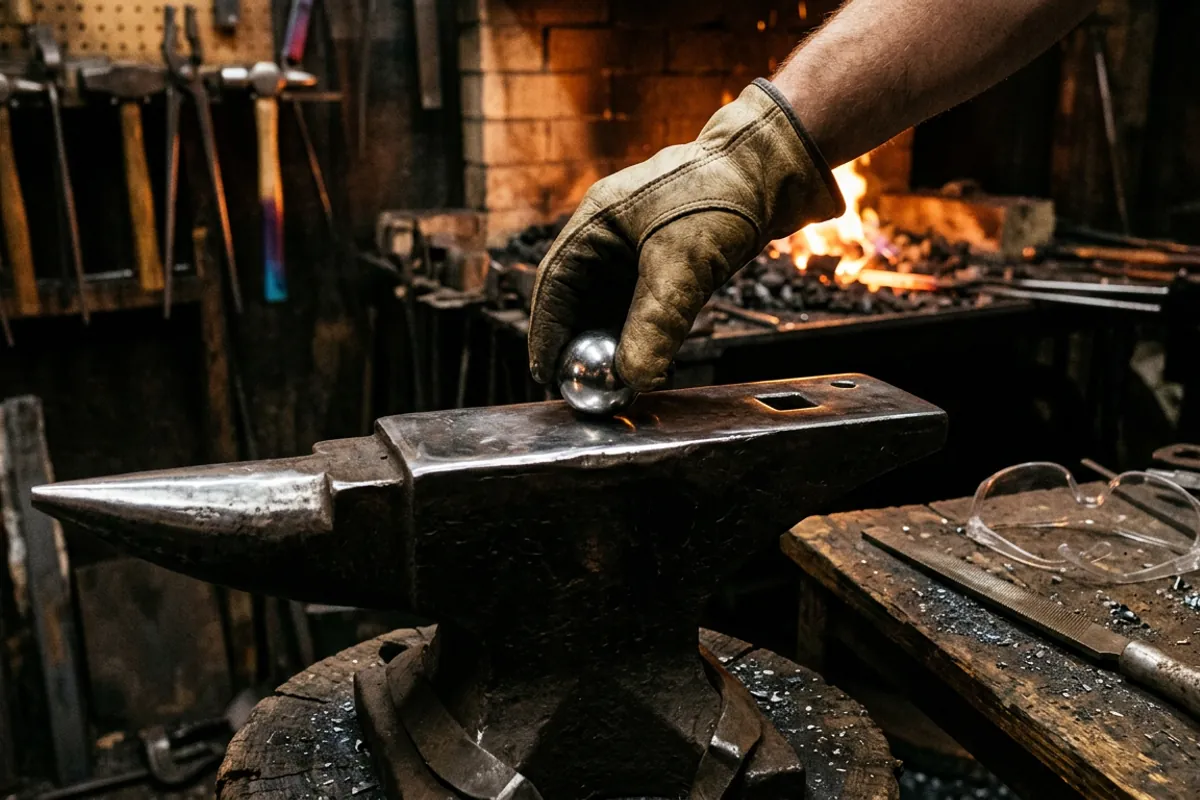
Bring a 1 in bearing ball and a tape. Drop the ball from a known height, say 10 in, onto the face and watch how high it comes back. Sixty to seventy percent or better across the face is a healthy anvil. Under about half, the face is soft, delaminated, or the anvil is iron. Test in several spots, especially over the waist and out toward the heel. The I Forge Iron rebound test thread is where I send people who want to see smiths argue the details of the method.
Then look at the face itself. Sway of a small amount is normal in an old anvil and often harmless. Chipped edges are cosmetic until they are not. Plug welds and repair patches show up as dead spots with no rebound at all, so the ball tells you what your eyes miss. Ring is a weaker signal than people think, because mounting and shape change it, but a dull thud where you expect a ring on a wrought body anvil is worth a second look for a crack.
On safety: anvils are dense and awkward, and a 130 lb casting dropped on a foot ends your forging season. Get help, keep your back out of it, and never let it rest where it can tip off a bench edge. Wear real boots. That goes in the same bucket as the rest of the shop kit I cover in blacksmith safety gear: the hazard does not care that you were only moving it a few feet.
What owners say
For the gear here that I have not run down in my own shop, this is what the forums report, with the thin spots marked.
On NC Tool anvils, signal is decent and mostly positive. The I Forge Iron NC Tool Co anvils thread is the long running discussion, and the tone there is that these are competent working castings rather than heirlooms, popular with farriers and used by plenty of smiths. The recurring caution is weight: people who buy the 70 lb version for general blacksmithing often wish they had bought heavier.
On Harbor Freight and the import castings generally, the older cast iron units are universally panned in the Harbor Freight anvils thread, with owners describing deformation from light blows and no rebound. Reaction to the cast steel Doyle has been more open, though it is newer and there is less long term data than I would like before making a strong claim.
On VEVOR and the SmarketBuy style imports, the owner signal is genuinely thin and scattered across retail reviews rather than smithing forums, which is why I will not tell you what a consensus says. What I see repeated by people who own them is acceptable rebound, edges that mark easily, and paint on the face out of the box. Take that as a shape rather than a verdict.
On price, BladeForums' long thread on average anvil prices is a useful sanity check before you agree to a number on a listing.
What I would tell a friend
Buy used if you can be patient. A sound 100 to 150 lb American pattern anvil at $7 per pound or less beats everything new in this price range, and it will outlive you. Check estate sales, farm auctions, and the club forge bulletin board before the internet.
If you need new today and can spend for it, the NC Tool 70 lb Big Face is a real tool with published geometry and a long service record, and it is what I would buy new at that weight. If you are buying on price, buy cast steel and buy weight, which points at the 132 lb import over any 66 lb one. If a listing will not tell you the material, it is cast iron and you should walk.
Whatever you buy, mount it dead solid at knuckle height, break the sharp edges with a file, and spend your next dollars on a decent hammer rather than a bigger anvil. I made that mistake in the other order. There is more on that in the hammer buying guide, the full anvil buying guide, and the rest of the anvils topic hub.