Everything I need is verified. Both ASINs appeared live in this session's search with matching titles (B0711DLST1 Old World forged steel 100 lb; B0819K93FG Happybuy 132 lb cast steel), and I have published 500-lb-class specs from Nimba, Pieh/TFS, and Refflinghaus, plus real forum threads. Writing now.
If you want a real 500 lb anvil for sale, buy one from a maker who actually pours or forges steel for anvils, and walk right past anything described as cast iron. In the 500 pound class that means a Nimba Gladiator, a Refflinghaus, or a heavy forged pattern from a supplier like Centaur or Blacksmiths Depot. But before you spend that money, be honest with yourself about whether you need 500 pounds at all, because most home shops are finished growing long before they get there. I forge on Bessie, my 148 lb Trenton, and I have never once wished she were three times heavier. I want to be straight up front: I do not own a 500 lb anvil, so everything here leans on published maker specs, prices off real supplier pages, and what owners report on the forums, all weighed against years of running an anvil daily. This is not a bench test. It is a buyer's map.
Who actually needs a 500 lb anvil
Anvil mass does one thing that matters: it returns your hammer energy back into the work instead of soaking it up. A light anvil bounces around and eats your effort. A heavy anvil sits dead still and gives the blow back to the steel. That is real, and it is why nobody serious forges on a 40 pound cast-iron doorstop.
But there is a ceiling on how much mass a single person swinging a one-hand hammer can actually use. The old rule of thumb, repeated on every forum, is that you want roughly 50 times the weight of your hammer in anvil. Swing a 3 pound hammer and a 150 pound anvil already puts you well past that. One experienced smith on BladeForums put it plainly: unless you are going to have a couple of strikers with 12 pound sledges, there is nothing a one-hand hammer will do that needs more than about 150 pounds under it. The late Francis Whittaker, a well known American smith, worked his whole career on a 150 pound anvil.
So who is the 500 pound class actually for? Shops that run a striker or a team on heavy stock. Smiths doing architectural work, big tenons, heavy drawing of thick bar by hand. Farriers and production shops that want an anvil that will outlive three owners without a mark. If that is you, a 500 lb anvil for sale is a tool, not a trophy. If you are a weekend smith making hooks, knives, and hardware, you are buying mass you will never load. Read what size anvil you actually need before you let the number seduce you, and if you are still deciding on your first serious anvil, the 200 lb class is where most home shops should stop.
What a real 500 lb anvil costs, and where they come from
Here is the first hard truth: a genuine 500 lb anvil is a specialist purchase, and you will not find one waiting in a warehouse near you. These are special-order or short-run items. The TFS 500 lb single horn is listed as a special order with fluctuating price and motor-freight shipping, per Pieh Tool. A Nimba Gladiator at 450 pounds is made to order in the USA. Refflinghaus anvils in the 550 pound range come out of Germany through a single importer.
The second hard truth is the price. A quality anvil runs a few dollars per pound and up, and heavy premium anvils push the top of that. A Nimba Centurion at 260 pounds lists at 1,805 dollars on the maker's site; the 450 pound Gladiator sits well above that. Refflinghaus anvils in this weight are four-figure purchases before freight, and freight on a 500 pound object shipped on a pallet is not cheap either. Budget for the crate, the liftgate, and getting the thing off the truck and into your shop, because a 500 pound anvil does not go in the back of a sedan.
That is exactly why the used market matters at this size. Big vintage anvils, old Peter Wrights, Trentons, Fishers, and Hay-Buddens in the 300 to 500 pound range do come up, and a sound old wrought-iron-bodied anvil with a good steel face can be a better buy than a new import if you know how to check it. That is a whole skill of its own; I walk through it in the used anvils buying guide, and it is worth reading before you hand over cash for anything old and heavy. What an anvil should cost, new or used, is its own subject too; see what an anvil price really tells you.
The 500 lb-class anvils worth knowing
I have not forged on any of these, so treat this as a spec-and-reputation comparison, not a shootout. What I can tell you is which ones are built like real anvils and which construction to trust. Every figure below is the maker's or importer's published number, cited.
Scroll horizontally to see all columns.
| Anvil | Weight | Material | Face width | Hardness | Price tier |
|---|---|---|---|---|---|
| Nimba Gladiator | 450 lb | 8640 cast steel | 7 in | 50 to 52 HRC | Premium |
| TFS single horn | 500 lb | Cast ductile iron | not published | 52 HRC | Mid to premium |
| Refflinghaus No. 9 | 550 lb | Proprietary tool steel | 6.5 in | 59+ HRC | Premium |
The Nimba Gladiator is 450 pounds of 8640 cast steel, heat treated to 50 to 52 Rockwell C, with a 7 inch wide face, 13 inches tall, and 39 inches tip to tip. It is an Italian-style double-bick pattern, made in the USA, sold with a lifetime guarantee. 8640 at 50 to 52 is a proven anvil combination: hard enough for excellent rebound, tough enough not to chip. This is the one I would point a striker-team shop toward first.
The TFS 500 pound single horn is cast ductile iron, heat treated, rated at 52 Rockwell, with a 1 inch hardy hole and 1/2 inch pritchel. TFS anvils have a solid working reputation and this is one of the few ways to buy a full 500 pounds new without going to a four-figure European import. Ductile iron is not the same as forged tool steel, but properly heat treated it makes a serviceable, hard-faced anvil, and owners who run them are generally happy. Just know what you are buying.
The Refflinghaus sits at the top. The No. 9 in the 550 pound size has a 6.5 inch face, and the importer guarantees the main face and horns to at least 59 HRC, which is harder than almost anything else on this list. That hardness is what a lot of high-end owners chase: a face that returns nearly every bit of the blow. You pay for it, and the wait can be long, but nobody who buys one seems to regret it.
What you will actually find online, and its real limits
Now the reality check for anyone typing "500 lb anvil for sale" into a marketplace search box. The heavy new anvils above do not live on Amazon. What lives there tops out far lower, and a lot of it is junk. If a listing says "cast iron" and shows a 500 pound anvil for a couple hundred dollars, it is a decoration, not a forging tool. Cast iron has no rebound and dents under a hammer. Do not buy it at any weight.
What you can honestly buy online is a smaller, real anvil to get started or to scale down to a size you will actually use. Two that show up consistently:
A forged option like the Old World Blacksmith 100 pound forged steel anvil (paid link) is drop-forged and tempered steel, not cast iron, with the maker citing about 52 Rockwell at the step. At 100 pounds it is a genuine working anvil for a one-person home shop, and forged construction is the right thing to look for at this price. Check price on Amazon (paid link). It is nowhere near 500 pounds, and for most readers here, that is the point.
On the budget end, a single-horn cast-steel anvil like the Happybuy 132 pound (paid link) is the kind of import a lot of new smiths cut their teeth on. Cast steel, not cast iron, so it will actually forge, though rebound and edges are hit or miss from unit to unit and the fit and finish are rough. It is a starter, not a lifetime tool. Check price on Amazon (paid link). The same class of budget import shows up under the VEVOR label as well, and the feed card below is the closest single-horn equivalent:

If your search for a 500 pound anvil was really a search for "the most anvil I can afford right now," one of these gets you forging while you save for the real heavy anvil, or while you decide you never needed one. For the fuller rundown of what to look for at any weight, my anvil buying guide covers the checks that matter, and the topic hub collects the rest.
How to check a heavy anvil before you buy
Whether you are looking at a new import or a 400 pound antique on a pallet, the tests are the same, and at this weight and price you must do them or bring someone who will.
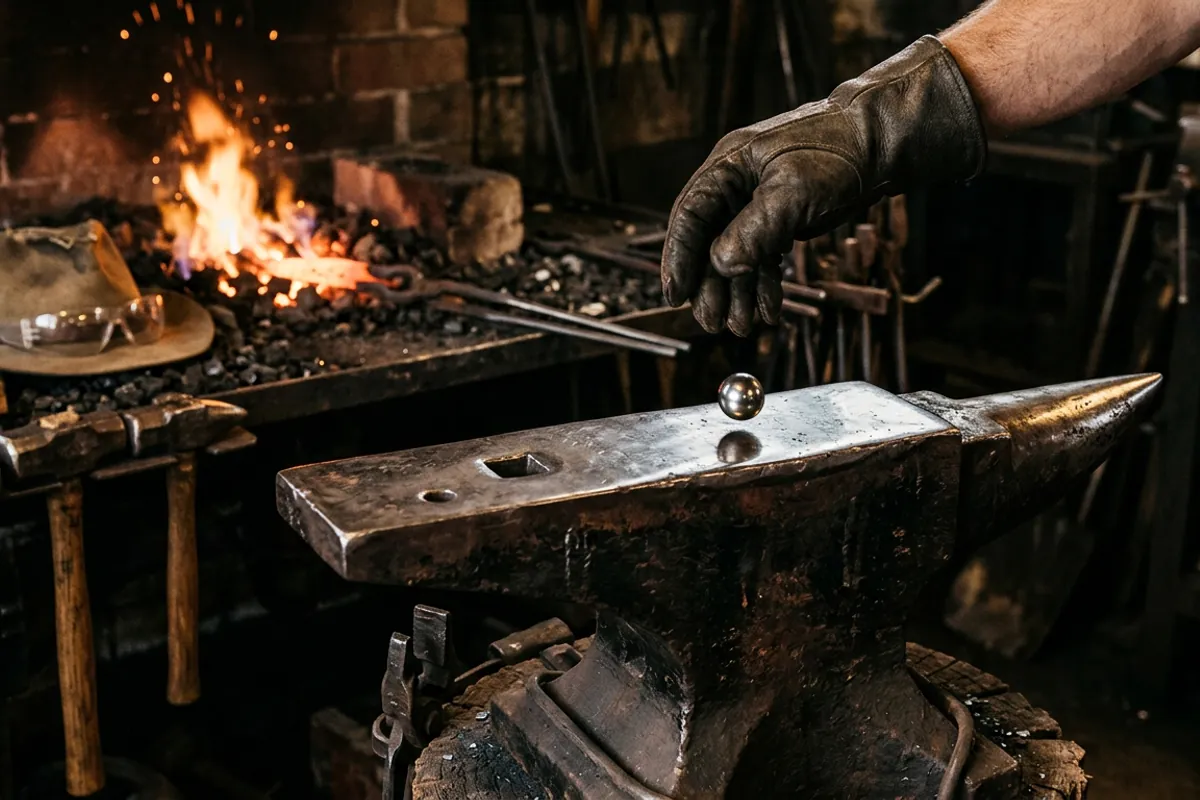
Rebound first. Drop a steel ball bearing, a 1 inch is ideal, from a fixed height onto the face and watch how high it comes back. A good hard-faced anvil returns 70 percent or more of that height; the best return 90 percent. A dead, thudding bounce means a soft or cast-iron face, and on a heavy anvil that is a very expensive mistake. Test the middle of the face and both ends, because a worn or delaminated face can be good in one spot and dead in another.
Ring is secondary but tells you something. A sound anvil with a solid face rings when you tap it. A dull thunk can mean a cracked body or a face lifting off the base, though some big anvils and some patterns ring quietly by design, so use ring to raise questions, not to reject outright.
Then look. Check the face for chips, deep swayback, and edge damage. A little sway and rounded edges are normal on a working anvil and honestly useful. A cracked face or a face separating from the body is a walk-away. On an old anvil, look hard at the plate-to-body weld line for any sign the steel face is lifting. On a new one, look at the hardy and pritchel holes for a clean cast or forged finish rather than a rough afterthought. Hardness numbers matter here too; if you want to understand why face hardness and heat treat drive rebound, Knife Steel Nerds is the place to read real testing rather than marketing.
What owners say
For gear I have not run down myself, here is the consensus I could actually find, attributed, complaints and all.
On going big at all, the forums are split in a useful way. On Bladesmith's Forum and BladeForums, the recurring theme is that 150 pounds is plenty for one-hand hammer work and that the smiths chasing 400 and 500 pound anvils are either running strikers or just want a heirloom that will never wear out. Both are valid reasons, but the second is a want, not a need, and the honest owners say so.
On Nimba, owner signal is thin but consistently positive. Threads on BladeForums and the bladesmith boards describe them as well cast, well finished, with excellent rebound and no soft spots, which tracks with the published 8640 at 50 to 52 Rockwell. The main complaint is price and lead time, not the tool.
On TFS ductile-iron anvils, owners on the farrier and smithing forums generally report good rebound and good value for a new anvil, with the usual caveat that ductile iron is not forged tool steel and the edges are a touch softer than a top-tier anvil. For the money and the weight, most owners consider that a fair trade.
On the budget imports, the Happybuy and VEVOR style single-horns draw the most mixed reviews of anything here. Owners report they will forge, but rebound varies unit to unit, edges chip if you work cold or hit hard, and finish is rough. The consensus is that they are fine to learn on and not worth pretending they are a lifetime anvil. That matches everything I have seen handling them at club events, and it is why I steer beginners with patience toward a good used anvil instead.
What I would tell a friend
If you genuinely run a striker or forge heavy stock and you want a 500 lb anvil for sale that you will hand down, buy a Nimba Gladiator or a Refflinghaus and be done thinking about anvils forever. Both are real steel, real hardness, real rebound, backed by makers who stand behind them. The TFS 500 pound is the sensible middle if you want the full weight new without the top-tier price, as long as you accept ductile iron for what it is.
But for most people who land on this search, the honest answer is that you do not need 500 pounds, and buying it would be spending rent money on mass you will never use. A sound 150 to 250 pound anvil, new or used, will serve a home shop for life. If you are starting today and want something you can order online and actually forge on, the forged 100 pound is the pick over any cast-iron pretender at any weight.
And whatever you buy, wear the eye protection every single time you swing at it. Hot scale flies off an anvil face at speed, and a hard hammer face can throw a chip. Rated Z87.1 glasses are a few dollars. I quenched a blade too close in a cotton shirt early on and the oil flared and took my eyebrows; I got lucky with my eyesight. Buy the anvil once, and protect the eyes you only get one set of.