Both ASINs verify live and match their titles, and I have maker specs plus real forum threads. Writing the guide now.
Most people who search "charcoal forge for sale" are about to spend money on the wrong thing, so let me lead with the honest verdict: a charcoal forge is the one forge on this whole site I would tell you to build before you buy. The fire is a hole with air blown into it. You can dig that hole in a box of dirt for the cost of a bag of charcoal and a hair dryer, and it will forge weld. But if you want something welded, portable, and ready out of the box, the thing actually for sale under that search term is almost always a solid fuel firepot or a small hand crank furnace, and a couple of them are worth the money. What follows are not bench tests in my shop. They are the published specs and the owner reports from the forums, weighed against twenty five years of running a coal forge and a propane forge next to each other.
Let me be clear up front about what I own and what I do not. I run a coal forge for heavy stock and forge welding and a propane forge for most day to day work. I have burned lump charcoal in the coal forge plenty of times when I ran low on coal, so I can speak to how charcoal behaves in a solid fuel firepot. I have not personally owned the specific Simond Store units below, so where I talk about them I am reporting what the maker publishes and what owners say, and I will tell you which is which.
What you are actually shopping for
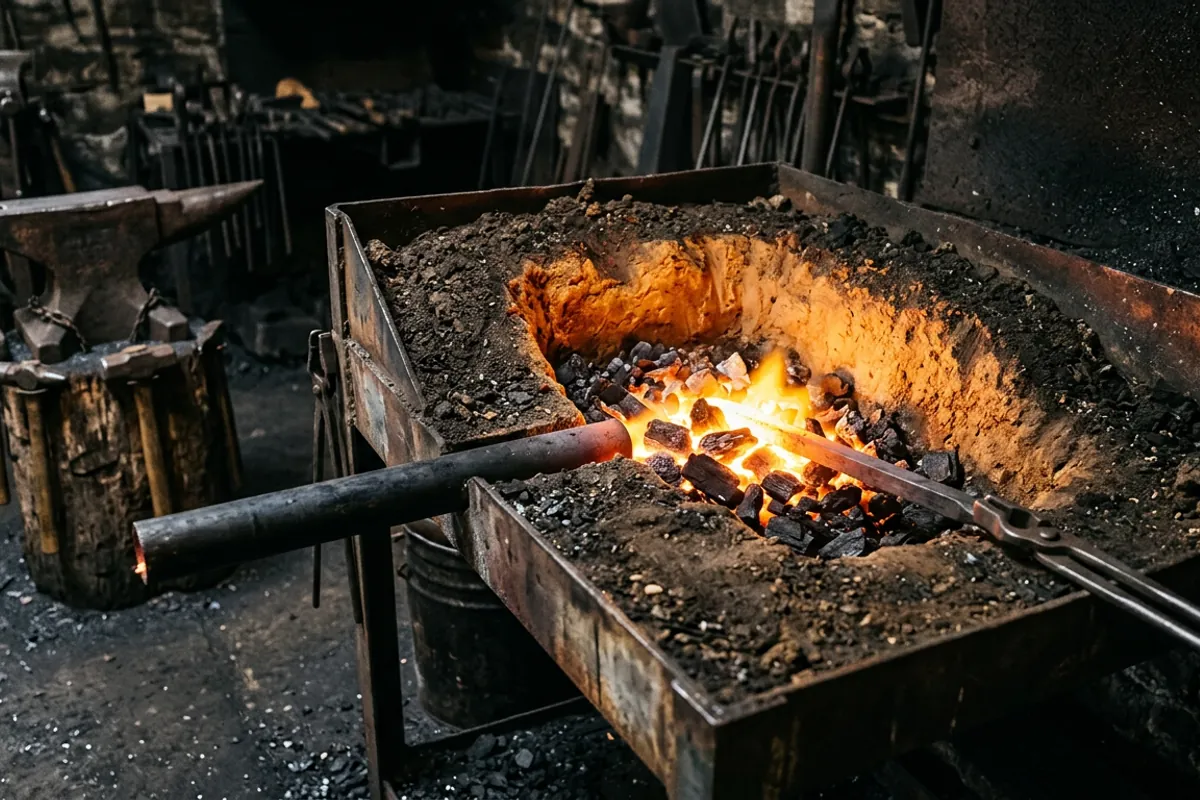
There is no such thing as a dedicated "charcoal forge" as a product category. Charcoal is a fuel, not a forge design. What gets sold under that name is a solid fuel forge: a steel firepot with an air inlet underneath, sometimes bolted to a table, sometimes bundled with a hand crank blower. You feed it coal, coke, or charcoal. The same firepot that burns coal burns charcoal, so every "coal forge for sale" listing is also a charcoal forge for sale. Do not let the wording send you hunting for a special charcoal only unit that does not exist.
The real decision splits three ways. One, buy a bare welded firepot and build your own table and air supply around it. Two, buy a complete small furnace with the blower already attached. Three, build the whole thing yourself from a steel box, a length of pipe, and a bag of dirt, which is the route most experienced smiths will push you toward and the one I would take again. I cover the full comparison in the coal versus propane forge guide and the deeper build discussion lives on the forges topic hub.
Charcoal is not coal, and it changes what you buy
This matters before you spend a dollar. Charcoal is lighter and less dense than bituminous forge coal, it burns faster, and it wants a lot of air moving through it. A firepot sized and airflowed for coal will eat through charcoal quickly and burn a wider, shallower fire. That is not a defect. It just means charcoal likes a slightly different fire management style: a deeper pile, steady air, and a fire you rake in more often.
The single biggest thing charcoal changes is that it strongly favors a side blast fire, where the air comes in from the side through a tuyere, over a bottom blast, where air comes up through the grate. Almost every welded firepot sold online is a bottom blast design. It will absolutely burn charcoal and it will get to welding heat, but the smiths who burn charcoal seriously tend to run side blast trench forges for a reason: less fuel burned to make the same heat, and a cleaner fire. If charcoal is your permanent fuel and not just what you have on hand, weigh that before you buy a bottom blast pot. For the fuel side of this, the coal forge coal buying guide walks through what actually burns well and what to avoid.
The field at a glance
Only published figures are in this table. Where a maker does not state a number, it says not published rather than a guess.
Scroll horizontally to see all columns.
| Forge | Type | Firepot or chamber | Material | Air source | Price tier |
|---|---|---|---|---|---|
| Simond Store welded firepot kit | Bottom blast solid fuel | About 10 by 12 by 5 in | 1/2 in plate steel, rated to 2600 degrees F | Bring your own blower | Budget |
| Simond Store furnace with hand blower | Bottom blast solid fuel | Not published | Steel | Hand crank pedal blower included | Budget to mid |
| Box of dirt build (JABOD) | Side blast, your design | Whatever you dig | Steel box plus dirt or clay | Hair dryer or blower | Cost of materials |
Firepot dimensions, material, and the 2600 degree F rating are from the Simond Store product page for their 10 by 12 firepot.
Simond Store welded firepot kit
This is the one I would point a buyer at first if they want steel and not dirt. It is a welded firepot, roughly 10 by 12 inches with about a 5 inch depth, cut and welded from half inch plate steel and rated by the maker to 2600 degrees F. That plate thickness is the number that matters. A firepot lives its whole life with fire sitting in it, and thin sheet steel warps and burns through. Half inch plate is honest material for the job and is the reason this one comes up again and again as a sane budget starting point.
What you are buying is the pot, not a finished forge. You supply the table it sits in and the air. That is a feature, not a flaw: it means you build the forge around your own height and shop, and you can run a proper blower instead of whatever came bundled. Set it into a steel or masonry table, plumb a gate valve into the air line so you can throttle the blast, and you have a forge that will outlast a lot of complete units sold at the same price.
Check price on Amazon (paid link)
The honest tradeoff: it is a bottom blast pot, so for charcoal specifically you are fighting the fuel a little, as covered above. And it is a firepot, meaning the first day is a build day, not a forge day. If you want to strike steel the afternoon the box arrives, this is not that.
Simond Store furnace with hand blower
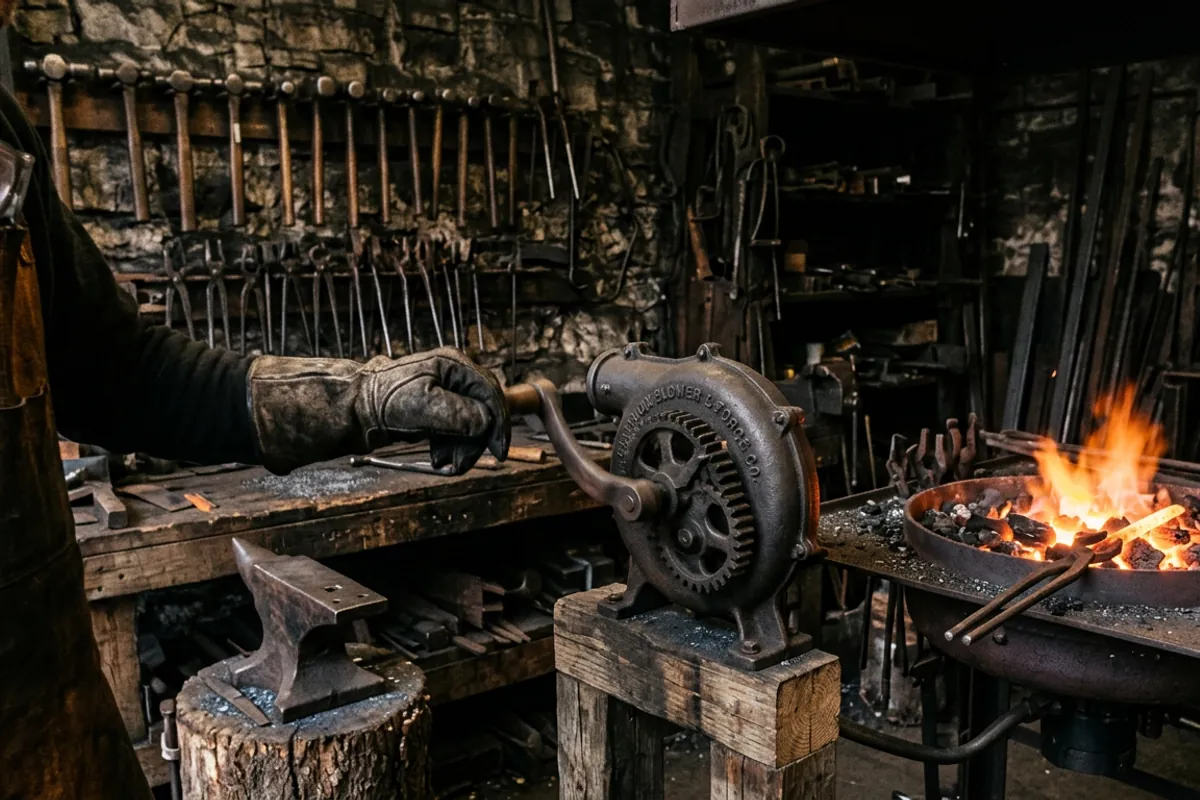
This is the closer thing to plug and play. It is a vintage style solid fuel furnace with a hand crank blower on a pedal type handle already attached, so the air supply problem is solved for you out of the box. For someone who does not want to source a blower and plumb an air line, that is a real convenience, and it is why this style keeps selling.
Simond Store does not publish firepot dimensions, wall thickness, or a temperature rating for this unit the way they do for the bare firepot, so I am not going to invent those numbers. Treat the specs as not published and judge it on the blower and the build quality owners report rather than on a spec sheet.
Check price on Amazon (paid link)
The tradeoff here is that hand crank convenience costs you control. A geared hand blower gives you a strong blast but you are turning a crank with one hand while managing steel with the other, and fine air control is harder than with a valved electric blower you set and forget. For a farrier heating a shoe it is fine. For long sessions at the forge, plenty of smiths swap to an electric blower and a gate valve within a month. Know that going in.
The forge I would build before I bought either
I am not going to bury the lede I opened with. For a first solid fuel forge, especially a charcoal one, the box of dirt build wins on almost every axis that matters to a beginner. JABOD, "just a box of dirt," is exactly what it sounds like: a steel box or tray, packed with dirt or clay, with a steel pipe run in from the side as the air tuyere. That side blast geometry is the one charcoal actually wants, it costs a bag of charcoal and materials you likely have, and it forge welds. The I Forge Iron community has a whole subforum of these builds documented step by step in the JABOD build threads, and The Crucible's home forge guide walks through the same brake drum and box approaches.
The reason I push this is not thrift for its own sake. It is that building your own fire teaches you how the fire works: where the hot spot sits, how much air is too much, how deep the fuel bed needs to be. You learn that on a fifteen dollar box faster than on a hundred dollar pot, and everything you learn transfers straight to a bought forge later. If you want the full walkthrough, the homemade forge build guide lays out the parts I would buy and the ones I would fabricate.
What owners say
For the bought units I am leaning on owner consensus, not my own bench, and I will keep the two straight.
On the Simond Store firepots, the recurring theme across forum mentions and the reason they get recommended is the half inch plate: owners consistently note the pot is heavy, thick, and does not warp the way thin imported pots do, which is the failure mode that kills cheap firepots. That tracks with the maker's own published construction. The common caution is the same one I raised: it is a bottom blast pot, and charcoal purists on the solid fuel forums prefer a side blast for the fuel savings.
On complete hand crank furnaces of this type generally, owner signal is thinner and more mixed, so I will say that plainly rather than dress it up. The praise is convenience and getting a working fire fast. The complaints cluster on the blowers: gearing that feels rough, and a blast that is hard to modulate finely, which is why so many owners end up moving to an electric blower and a gate valve. Take that as a pattern in the reports, not as a test I ran.
The strongest consensus of all, across I Forge Iron's JABOD subforum and the general beginner threads, is the one I keep coming back to: your first solid fuel forge should be cheap and homemade, because you will change your mind about what you want once you have burned a few fires. That is not my opinion dressed as fact. It is what the room says over and over.
Safety, and I will not soften this
Solid fuel forges make carbon monoxide. You cannot smell it and it will kill you. A charcoal or coal fire indoors without real cross ventilation or an active flue is genuinely dangerous, and every year someone learns that the hard way. Forge outdoors or under an open sided roof, or run a proper hood and stack. Do not run one in a closed garage.
Eye protection is not optional at the forge or the grinder. Wear glasses rated to ANSI Z87.1. Scale flies off hot steel, and a hammer blow can send it into your face. Dress in natural fibers, cotton or wool or leather, never synthetics near heat: I quenched a blade in oil that was too cold once, standing too close in a cotton shirt, and the flare took my eyebrows. Cotton scorched. A synthetic shirt would have melted onto my skin. That is the whole reason this site treats PPE as a rule and not a suggestion, and it applies double to a solid fuel fire that throws sparks. The full rundown is in the blacksmith safety gear guide.
What I would tell a friend
Build it first. A box of dirt with a side blast pipe will teach you charcoal and forge weld steel for the price of a bag of fuel, and nothing you spend learns faster. If you want steel over dirt, buy the Simond Store welded firepot for its half inch plate and build your own table and air around it. If you genuinely will not fabricate anything and want a working fire out of the box, the hand blower furnace does that, with the honest caveat that you will probably swap the blower before long. Whatever you burn, forge outside or under a real hood, wear Z87.1 glasses and natural fibers, and treat the carbon monoxide as the serious hazard it is. The forge is the cheap part. Your lungs and your eyes are not.