I have verified products and specs. Writing the article now.
Here is the article:
If you are shopping "coal forge for sale" and want the short version, here it is: for most people starting out, the smartest buy is not a complete forge at all but a good welded firepot you drop into a steel table you build yourself, and the SIMOND STORE welded coal firepot (paid link) is the one I would build a shop around. If you want something you can set down and light the same afternoon, a complete portable rig with a blower already attached earns its keep. Before I get into picks, the honest framing: I run a coal forge and a propane forge in my own shop, so I can speak to how coal behaves and what makes a firepot worth owning, but I have not bench tested every model below. These picks lean on published specs, owner reports from the forums, and twenty five years of feeding a coal fire, weighed against each other.
How I judged these, and what I did not do
I own a coal forge. I do not own every firepot and portable forge on the market, and I am not going to pretend I do. So this guide splits into two kinds of knowledge. The first is what any experienced smith can tell you cold: how a coal fire actually works, why firepot depth matters more than the sticker, what a clinker breaker earns you, and where cheap steel bites you. That part is mine. The second is model-specific detail, which comes from manufacturer and retailer spec pages I fetched, plus owner threads on I Forge Iron and other forums. Where owner signal is thin, I say so. That is the deal on this site: I would rather tell you a listing is unproven than dress up a sales page as a test I never ran.
A coal forge is also one of the few pieces of shop gear where "for sale" is a slightly loaded phrase. A huge share of working coal forges were never bought new. They are old rivet forges and cast firepots that changed hands at auctions and estate sales, and they are often better than what ships in a box today. So part of buying a coal forge is deciding whether you even want a new one. I will come back to that.
Coal, coke, and what you are actually burning
Before you spend a dollar on iron, understand the fuel, because it decides almost everything about the forge you need. Real smithing coal is bituminous coal, low in sulfur, that cokes as it burns. You bank green coal around the edges of the fire, it bakes off its volatiles and turns to coke, and you rake that coke into the center where the work sits. That behavior is the whole reason a coal firepot is shaped the way it is: a deep pot with a concentrated air blast underneath, so the hot heart of the fire is small, deep, and clean.
That is a different animal from charcoal, which burns faster and shallower and forgives a wider, sloppier fire. If you are torn between fuels, I wrote a longer piece on that in coal or propane: which first forge makes sense, and there is a dedicated buyer's take in the coal forge coal buying guide. The short version for shopping: if you cannot reliably get good bituminous smithing coal in your area, a coal forge is going to frustrate you, and you should look hard at propane or at a charcoal forge instead. Do not buy the forge and then go hunting for fuel. Confirm the fuel first.
Firepot or complete forge: the real decision
Here is the split that actually matters when you type "coal forge for sale" into a search bar. You are choosing between three things:
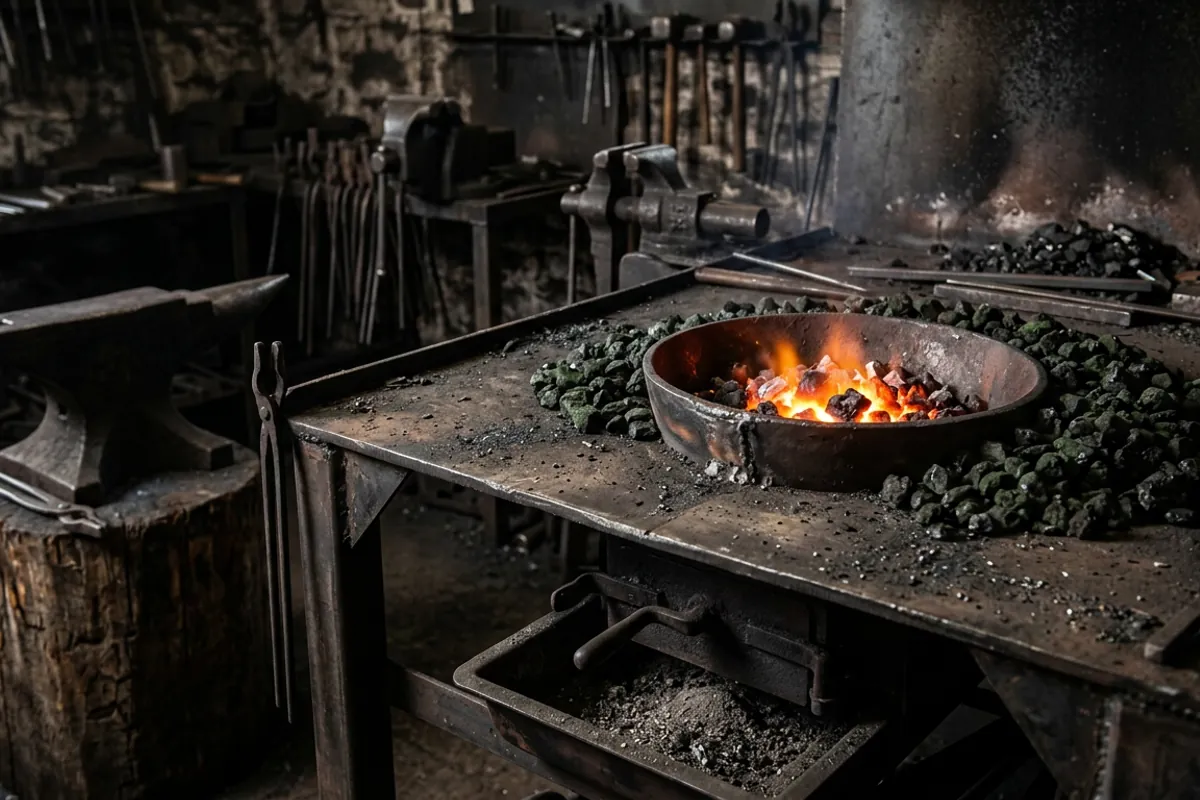
A firepot only. This is the cast or welded steel bowl with an air inlet (the tuyere) and usually an ash dump underneath. You supply the table, the legs, and the blower. This is the cheapest route to a genuinely good forge and the one most serious coal smiths end up on, because a table is just welded steel and you can size it to your shop.
A complete portable forge, meaning a pan, legs, and a blower already assembled, often in the old rivet-forge pattern. You set it down, crank, and go. You pay for the convenience and the blower.
A found antique. An old Buffalo, Champion, or Canedy Otto rivet forge off an auction site. Often the best value in the room if the tuyere and blower are sound, which is exactly the kind of thing I cover in the old anvil for sale guide applied to forges instead of anvils: buy the iron, not the story.
The single spec I would not compromise on is firepot depth. A shallow pan makes a wide, lazy fire that eats fuel and never gets your stock to a clean welding heat. For general work, owners on I Forge Iron repeatedly land on a firepot in the neighborhood of 4 to 5 inches deep, with a top opening around 8 to 10 inches, for stock up to about 1 inch. The classic cast Centaur Vulcan pot is 8 by 10 inches and 3 1/4 inches deep, which tells you the older commercial pattern ran a little shallower and relied on banking coke high above the rim.
Spec comparison at a glance
Only published figures are in this table. Where a maker does not state a number, it says so.
Scroll horizontally to see all columns.
| Forge / firepot | Type | Firepot / pan size | Material | Air feed | Price tier |
|---|---|---|---|---|---|
| SIMOND STORE welded firepot | Firepot only | 10 x 12 in, about 4.5 in deep (listed) | Welded steel plate | You supply blower | Budget |
| SIMOND STORE forge with hand blower | Complete portable | 10 x 12 in (listed) | Steel, pedal-type hand blower | Hand crank included | Mid |
| Upgraded welded coal firepot | Firepot only | 10 x 12 in (listed) | 1/2 in cast iron and steel plate, about 40 lb | You supply blower | Budget |
| Centaur Vulcan (reference) | Firepot only | 8 x 10 in, 3 1/4 in deep | Cast iron, about 45 lb | 3 in inlet, hand or electric | Premium |
| Centaur rivet forge (reference) | Complete portable | 17 3/4 in round pan, 2 in deep | 14 ga cold-rolled steel | 115V blower | Premium |
The two Centaur rows are there as reference points, not marketplace picks. They come straight off the Centaur Forge product pages (firepots and the rivet forge), and they show you what a premium, made-to-last pot and pan actually measure. Use them to sanity check whatever you are about to buy.
The firepot I would build a shop around
For the smith who is willing to weld or bolt up a table, a deep welded steel firepot is the best money in coal forging. The SIMOND STORE welded coal firepot (paid link) is the one I keep coming back to as a recommendation. It is welded steel rather than cast, the listing puts the pot around 10 by 12 inches with the deeper roughly 4.5 inch pattern, and that depth is the point: it lets you build the small, deep, concentrated fire that coal wants. Welded steel also will not crack the way a cast pot can if you let it slam cold or run it hard, though it will eventually scale and thin out where the fire sits hardest. That is normal wear on any firepot, not a defect.
The tradeoff with the firepot-only route is obvious: you are buying part of a forge. You still need a steel table, a stand, and a blower. If you already have a welder and some plate, that is a feature, not a cost. If you do not, factor in that build before you decide this is the cheap option. I would still take this over a flimsy all-in-one, because the pot is the part that has to survive the heat.
Check price on Amazon (paid link)
The complete portable forge if you do not want to build
If welding a table is not in the cards, a complete forge with the blower already hung saves you the fabrication. The SIMOND STORE coal forge with hand blower (paid link) is built in the old vintage pattern with a pedal or hand-crank blower feeding the pot, and it ships as a working unit. The appeal is simple: it is portable, it does not need shop power, and a hand crank gives you fine control over the air, which is genuinely nice when you are learning to read a fire.
Be clear-eyed about what a budget complete forge is. The sheet metal on the pan and stand is lighter than anything you would build, the blower is the cheapest sound part of the package, and the pot is usually shallower than the firepot-only options. For light stock, hooks, small blades, and learning the craft, that is fine. For heavy stock and serious forge welding, you will outgrow it, and at that point the firepot route or an antique is the upgrade. Owner reports on hand-crank forges of this class are consistent on one thing: the crank bearings and gears are the weak point, so keep them clean and lightly oiled.
Check price on Amazon (paid link)
The heavier cast-and-steel firepot
If you want more mass in the pot itself, the upgraded welded coal firepot (paid link) is listed as half-inch cast iron and steel plate at around 40 pounds, with a weighted ash dump underneath. That mass is worth something: a heavier pot holds heat, resists warping, and shrugs off abuse better than thin steel. The ash dump that opens to clear clinker and ash from the bottom is a real convenience on a long session, and it is the kind of feature the old cast pots were prized for.
The honest note is that "cast iron" in a budget pot means you treat it with a little respect. Cast iron does not like sharp thermal shock, so do not blast a dead-cold pot to welding heat in two minutes and do not dump water into a screaming hot pot. Warm it, work it, let it cool. Do that and a heavy pot like this outlasts a lot of the forge around it.
Check price on Amazon (paid link)
What owners say
For firepot dimensions, the most useful reading is not a product page, it is the long-running fire pot dimensions thread and the firepot depth thread on I Forge Iron. The consensus that emerges across those threads is the one I gave above: depth in the 4 to 5 inch range for general work, a modest top opening so the fire stays concentrated, and a strong preference among experienced smiths for building or buying a deep pot rather than a wide shallow pan.
On the budget import firepots specifically, owner signal is real but mixed, and I will not oversell it. The recurring praise is that a welded steel pot in this class does the job for the money and takes heat without cracking. The recurring complaint is quality control on the welds and the ash-dump hardware, which varies unit to unit, and that the included or matched blowers on the complete kits are the first thing to fail. Treat the blower as a consumable you may replace, not a lifetime part. Where I could not find deep, specific owner histories on an exact model, that is the thin signal I promised to flag rather than paper over.
Safety that is not optional
Coal forging has two hazards a propane forge does not, and I am not going to soften either. The first is carbon monoxide. Burning coal produces it, it is invisible and odorless, and it kills. A coal forge needs real ventilation, a proper hood and flue that actually draws, or open-air use. An enclosed garage with the door cracked is not ventilation.
The second is coal smoke and the fine particulate that comes off green coal as it cokes, which is not something you want in your lungs day after day. Add the sparks and scale that come off any hot fire, and eye protection rated to ANSI Z87.1 is the floor, not a suggestion, along with natural-fiber clothing rather than synthetics that melt to your skin. I have a full rundown in blacksmith safety gear, and I mean it: I lost my eyebrows to a quench-oil flare because I stood too close in a cotton shirt with no face shield, and I kept my eyesight on luck alone. Do not run your shop on luck.
What I would tell a friend
Buy the fuel supply first, the forge second. If you can get good smithing coal, the firepot-only route is the best value in the field, and the SIMOND STORE welded firepot (paid link) dropped into a table you build is where I would put a beginner who owns a welder. If you do not weld, a complete hand-crank forge gets you smithing this weekend, with clear eyes about its lighter build. And before you buy anything new, spend an evening looking at old rivet forges, because a sound antique often beats everything on this list. For the deeper decision behind all of it, my coal forge buying guide and the forges topic hub go further than a roundup can. Whatever you pick, hood it, vent it, and wear the eye protection. The forge is replaceable. You are not.