I have everything verified: three live ASINs (B08ML8HCHZ, B091SFMK9C, B07DJYMB2D), published specs from non-marketplace maker/retailer pages, and real owner-review sources. The only legal VEVOR refs are anvils, which don't belong in a propane-forge guide, so I'm not using the placeholder. Here's the article.
If you are shopping a propane forge for sale and you just want the short answer, here it is: for most home smiths I would buy the Hell's Forge double burner, because it is 11-gauge American steel and it holds heat like a unit that costs more. If money is tight, the Mr Volcano Hero single burner is the honest value pick, and the Simond Store single burner is the rock-bottom import that will still get a knife blank up to a forging heat. I run a propane forge in my own shop and have for years, but let me be straight about what this guide is and is not. I have not put these three specific models on my bench, so what follows leans on the makers' published specs and on what owners report on the forums, weighed against what I know about how a gas forge behaves once you light it. If you are still deciding between fuels at all, read coal or propane first before you spend a dime, and browse the rest of the forges hub while you are at it.
How I would shop a propane forge for sale
A propane forge is a simple machine: a steel shell, a ceramic fiber liner, one or more burners, and a regulator that feeds them gas. The listings dress it up, but you are really buying three things. First, the shell and how well it is built, because thin steel and four spot welds are where these things fail. Second, the liner, because that is what survives the heat and what flux will eat if you are careless. Third, the burner count and the chamber size, which together decide what you can actually fit inside and how evenly it heats.
Everything else on a spec sheet is noise. Ignore the temperature number until you understand what it measures, which I will get to, and ignore the word "portable," because every one of these is portable in the sense that it has a handle. Buy for the work you will actually do in the first year, not the work you imagine doing in year five. A beginner forging hooks, bottle openers, and small blades does not need a triple burner.
The forges at a glance
Here is the field, published specs only, cited in each product section below. Where a maker does not publish a figure I have written "not published" rather than guess at it.
Scroll horizontally to see all columns.
| Forge | Burners | Interior chamber | Liner | Rated temp | Made in | Price tier |
|---|---|---|---|---|---|---|
| Simond Store single burner | 1 | 2.75 x 4 x 10 in | 1 in ceramic fiber, firebrick floor | 2600F liner rating | Imported | Budget |
| Mr Volcano Hero | 1 | Not published | 1 in 8 lb Superwool XTRA, magma firebrick | 2600F liner rating | USA | Budget to mid |
| Hell's Forge double burner (HF2) | 2 | 19 x 6.75 x 3.5 in | 1 in ceramic fiber, two firebricks | Over 2300F reached in under 5 min | USA | Mid |
One honest note before you read that table wrong. The 2600F figures on the two single burners are the temperature the ceramic fiber liner will tolerate, not a promise the forge holds 2600F in the chamber. Hell's Forge instead publishes a heat-up claim, over 2300F in under five minutes. Those are two different measurements. What matters in the shop is that any of these three will hit a bright yellow forging heat for mild steel and most knife steels. Forge welding temperature is a harder ask, and I will come back to it.
Simond Store single burner, the budget import
This is the forge you buy when the budget is the whole story. Simond Store publishes an interior chamber of 2.75 in by 4 in by 10 in, a liner of 1 in ceramic fiber rated to 2600F over a rigid refractory firebrick floor, and a burner nozzle in SS-304 stainless, per the Simond Store product page. It ships with a hose and a stand and, honestly, that is a complete starting point for not much money.
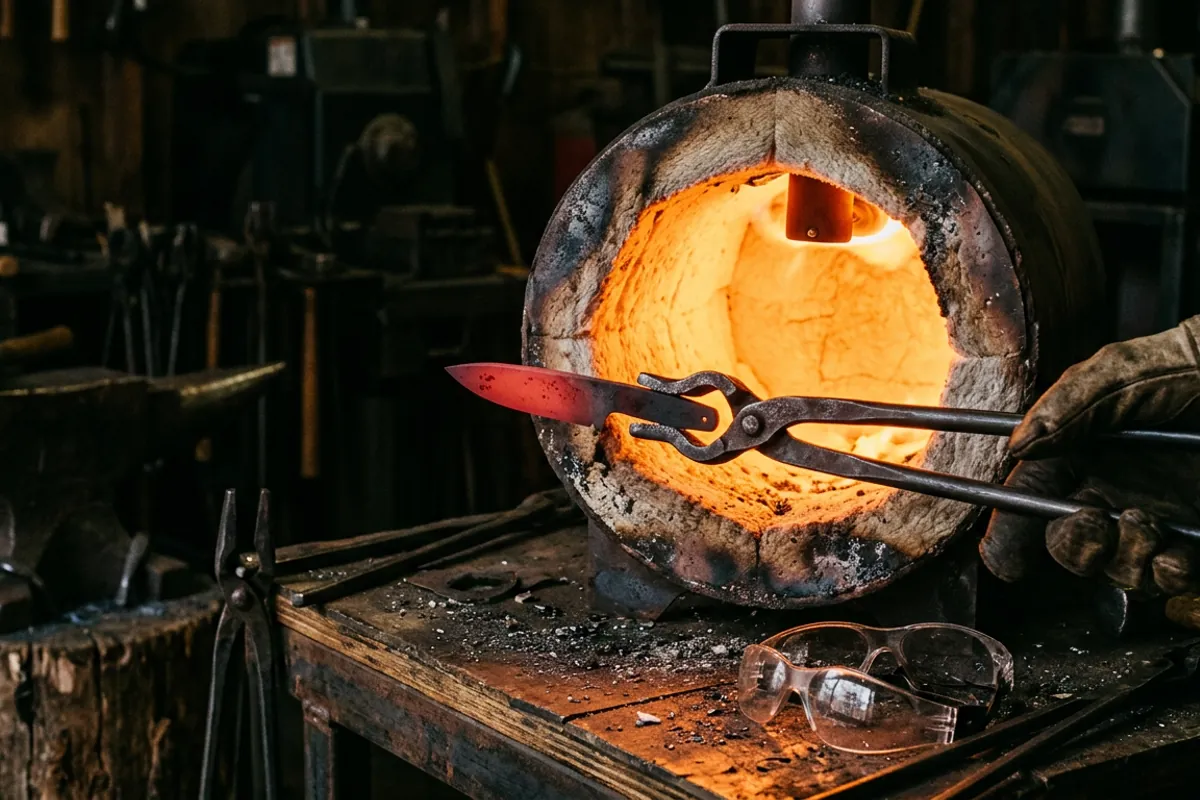
The tradeoffs are exactly what you would expect from an import at this price. The steel is lighter than the American units, the fit and finish is rougher, and you may want to re-coat the liner with rigidizer before you rely on it. The chamber is small, which is not automatically bad. A tight chamber heats faster and burns less gas, and for a beginner forging small stock that is a feature, not a flaw. What it is not is a forge welding rig or a place to lay a long blade evenly. If you want the cheapest honest door into the craft and you accept that you may outgrow it, this is a reasonable one.
Check price on Amazon (paid link)
Mr Volcano Hero, the USA made value kit
The Hero is the one I would point a value shopper at over the no-name imports, and the reason is the kit and the country of origin, not magic. Mr Volcano is a Minnesota company and sells the Hero as a complete kit: the stainless shell, the burner with a ball valve and choke, a 1 in 8 lb density Superwool XTRA fiber blanket, rigidizer, Satanite refractory mortar for the initial coat plus extra for maintenance, a magma firebrick, and a 6 ft hose with regulator, all per Mr Volcano's own listings. The liner is rated to 2600F. The maker does not publish a clean interior chamber dimension, so I am not going to invent one.
What you are paying for over the Simond is a better liner blanket, an adjustable choke on the burner so you can tune the flame rich or neutral, and a kit that does not make you hunt for parts. The catch is that it is a build-it-yourself kit. You coat and cure the liner yourself, and one owner review noted the cement shell is soft enough to dent with a thumb before it is fully cured, and that the burner socket threads came slightly gritty with cement debris. None of that is a dealbreaker, but go in knowing you are assembling a forge, not unboxing one. For a first serious propane forge in a home shop, the Hero is the value pick, and it pairs well with the thinking in my propane forge for a home shop guide.
Check price on Amazon (paid link)
Hell's Forge double burner, more chamber and 11-gauge steel
This is the one I would buy for a shop I meant to keep. Hell's Forge builds the HF2 from 11-gauge American steel, publishes an interior of 19 in by 6.75 in by 3.5 in in an oval chamber, lines it with a 1 in high density ceramic fiber blanket over two 9 in by 4.5 in by 1.25 in firebricks, and claims over 2300F in under five minutes, all per a retailer spec listing. Two burners across a long oval chamber is what gives you an even heat over a blade instead of one hot spot, and the heavier steel is the reason these outlast the light imports under real use.
The tradeoffs are real too. Two burners drink more propane than one, so if you only ever forge small parts you are paying to heat air. The chamber runs hot and open, which is great for capacity and worse for gas economy and for the noise, which brings me to the owners. If a double is more forge than you need right now, Hell's Forge sells the same build as a single burner, and the same logic applies: heavier steel, USA made, a step up in price from the imports. For knife work specifically, this chamber length is the reason I would take it over any single burner, and it lines up with what I say in the knife making propane forge guide.
Check price on Amazon (paid link)
What owners say
For gear I have not run down in my own shop, the forums and long-form owner reviews are the honest signal, so here is what they actually report.
On Hell's Forge, one owner who bought the double burner called it well built for the price and a good stepping stone for someone new to the craft, but was blunt about the drawbacks: it is very noisy, you must keep flux off the ceramic blanket because flux melts it, and every propane forge puts out carbon monoxide so you run it outdoors. That same reviewer noted the Hell's Forge burners point straight down into the chamber, where a lot of smiths prefer burners set at a slight angle for better flame circulation. That is a fair, specific critique and it matches the gallivanting craftsman review. None of it is a reason to skip the forge; it is a reason to run it outside with hearing protection and to be disciplined about flux.
On Mr Volcano, one detailed owner review of the two burner kit liked the complete package, the laminated instructions, the pre-cut insulation, and the safer low biopersistent fiber, and reported both burners heating so hard that scrap wood nearby caught from the radiant heat. The honest gripes were about the DIY build, the soft cured shell and gritty socket threads I mentioned above, per Doctor Hammer's review. That reviewer paid about 135 dollars for the two burner kit direct, which tells you these live in the budget tier even made in the USA. Separately, a blacksmith forum thread where smiths compared budget forges pointed newcomers toward Hell's Forge and Majestic as units that hold heat better and last longer under heavy use, at a higher price, and reminded people that a DIY build is still the cheapest durable path if you have the skills.
On the Simond and the other rock-bottom imports, owner signal is thinner and more mixed, which is itself the point. People get years out of them and people get liners that crumble, and the difference is usually whether the buyer rigidized and cured the liner properly before leaning on it. If you buy at the bottom, budget an afternoon to treat the liner and you will get a lot more forge for the money.
Single burner or double, and how much chamber you need
The single versus double question decides more than the price. A single burner in a small chamber lights fast, sips gas, and is plenty for hooks, bottle openers, small tongs, and short blades. A double burner in a long chamber is what you want the day you try to bring a whole knife blade to an even heat, or to forge weld a billet, because one burner over a long chamber leaves you with a hot middle and cold ends.
If knife making is the goal, I lean toward the longer double burner chamber for that even heat, even though it costs more to run. If general blacksmithing and learning the hammer is the goal, a single burner is the honest first buy and you will not feel starved for a good while. The mistake I see most is a beginner buying a triple burner "because bigger is better," then paying to heat an empty chamber every session. Buy for the stock you actually forge. If you want to go deeper on the burners themselves, the tradeoffs are their own subject in my propane burners for a forge writeup.
Fuel, regulators, and the safety that is not optional
Every one of these forges runs on a standard propane tank through an adjustable regulator and hose, and most kits include that hose and regulator. Run a high pressure adjustable regulator, not the low pressure grill type, because these burners need more pressure than a barbecue. Check every threaded joint with soapy water before you light it the first time and any time you break the connection down; a hiss of bubbles is a leak, and you fix it before there is a flame anywhere near it.
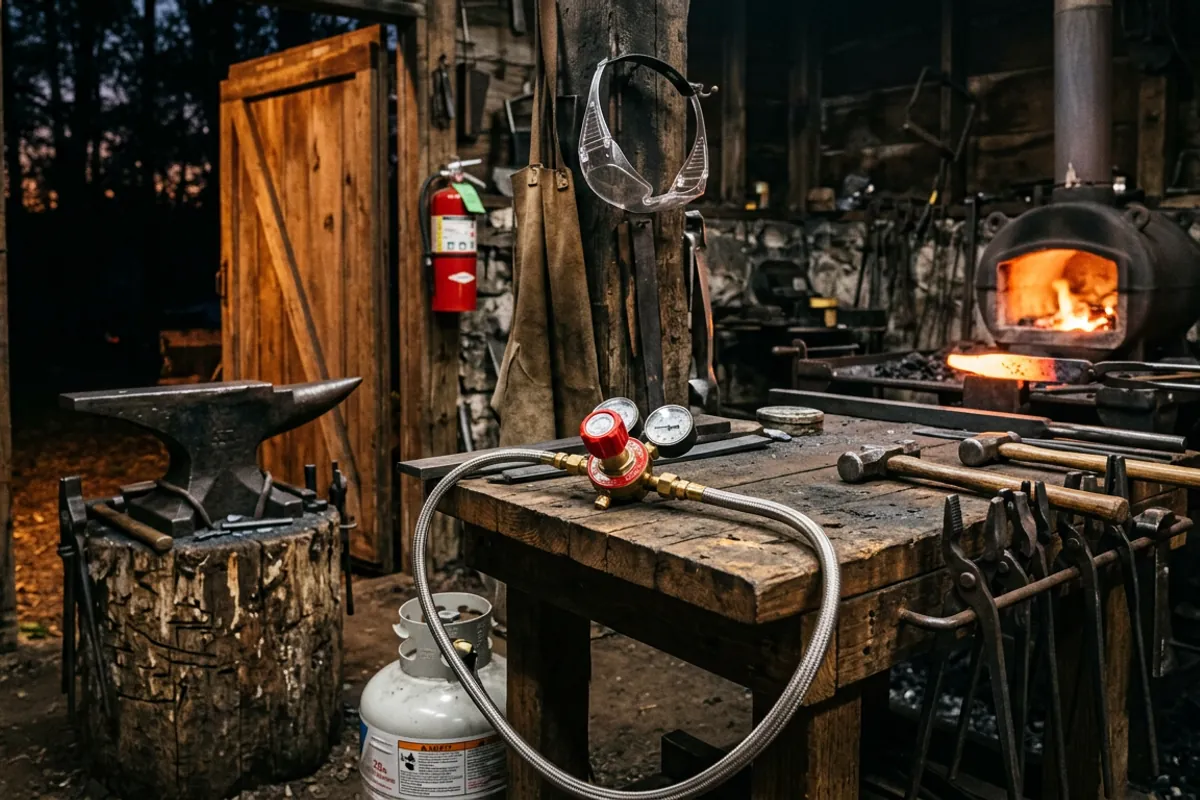
Now the part I will not soften, because I have the scar to justify it. A propane forge produces carbon monoxide, and every maker tells you to run it outdoors or under serious ventilation. That is not fine print. Carbon monoxide is invisible and it will put you down before you know anything is wrong, so you run these outside or in a shop with real cross ventilation and a working detector, full stop. Keep flux off the ceramic blanket, because molten flux eats the liner and shortens its life fast. Wear eye protection rated to ANSI Z87.1 at the forge and at the grinder, wear natural fibers like cotton or wool instead of synthetics that melt to your skin, and keep a fire extinguisher within reach. Early on I quenched a blade in oil that was too cold, standing too close in a cotton shirt with no face shield, the oil flared, and it took my eyebrows. I kept my eyesight by luck. The gear list is short and it is not the place to save money; my full take is in blacksmith safety gear.
What I would tell a friend
Buy the Hell's Forge double burner if you want one forge that lasts and you are serious about knives, buy the Mr Volcano Hero if you want a USA made kit at a lower price and do not mind assembling it, and buy the Simond Store single only if the budget is the deciding factor and you accept you may outgrow it. Skip the no-name triple burners a beginner does not need, and skip any listing that will not tell you the steel gauge and the liner. Whatever you pick, treat the CO risk and the flux the way I described, cure the liner before you rely on it, and you will get real years out of a modest forge. That is the honest state of the propane forge for sale market: the good ones are simple, the differences are the shell and the liner, and none of it beats running the thing outside with your eyes protected.