The 66 lb ductile iron block is the swage block I would point most home smiths toward when they start shopping. It is heavy enough to sit still under a hammer, it has the round, square, and hexagonal through-holes you will actually reach for, and it costs a fraction of a full-size cast block. If you go looking for a swage block for sale online, that is the size and style that solves the most problems for the least money in a hobby shop. Before I get into the picks, the honest framing: I own an anvil, two forges, and more tongs than I will admit to, but I have not run every one of these specific blocks across my own stump. What follows leans on published specs, the shapes each block actually offers, and what owners report on the forums, all weighed against twenty-five years of shop experience.
A swage block is one of those tools that looks like a novelty until the day you need to dish a bowl or true up a piece of round stock, and then nothing else in the shop does the job. It is also a tool a lot of beginners buy too big, too early, or in the wrong material. So this guide is as much about not wasting money as it is about which block to buy.
What a swage block actually does
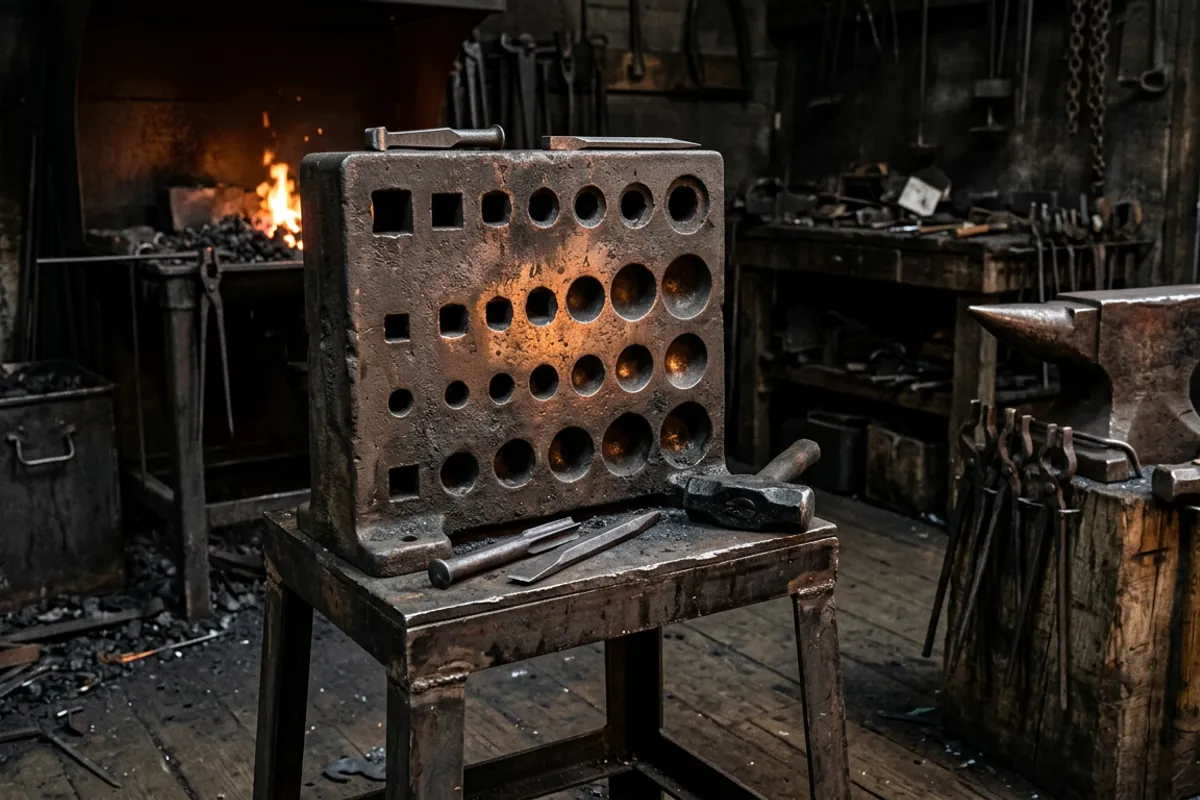
A swage block is a heavy chunk of cast metal with shaped depressions on its faces and through-holes of different profiles around its edges. You back up hot steel in one of those forms and drive it into shape with a hammer or a top tool. The bowls dish sheet into spoons and ladles. The half-round grooves turn square stock round and round stock into half-round. The square and hexagonal holes let you neck down or true up a tenon or a bolt head. The perimeter notches back up bar you are bending or upsetting.
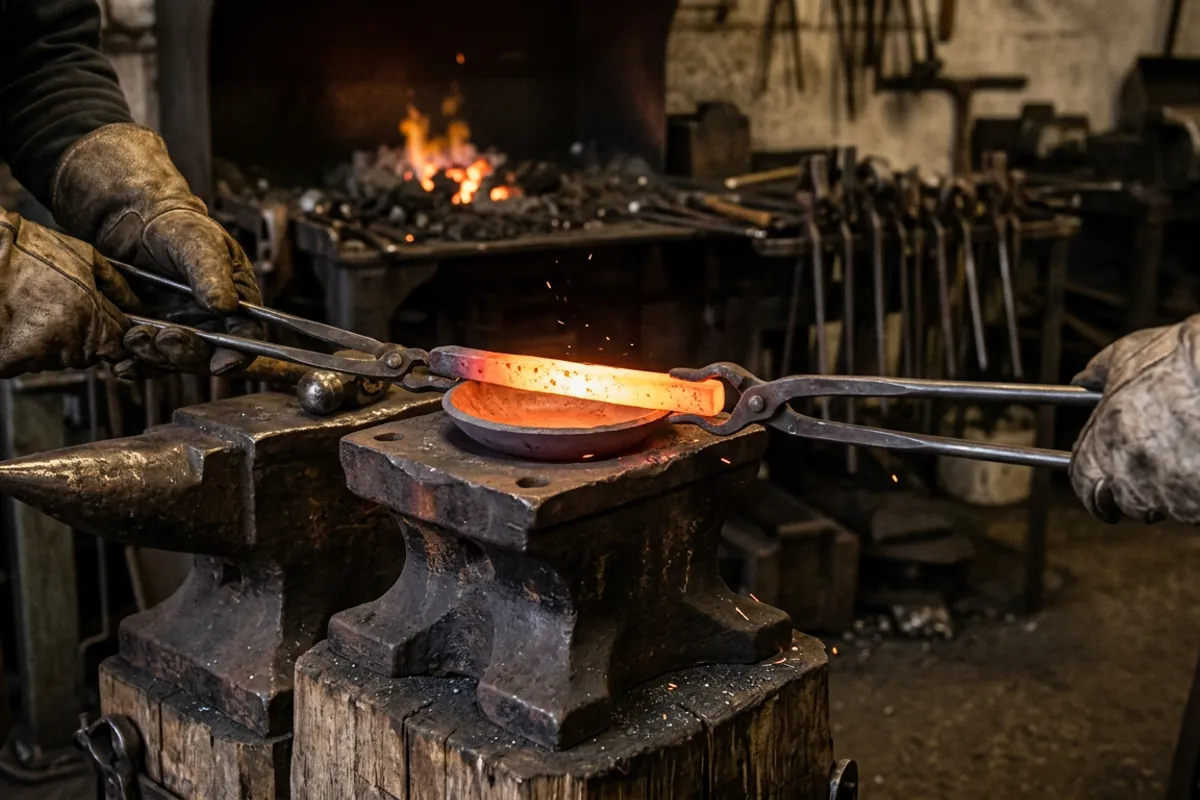
Here is the part nobody tells a beginner: a swage block is a forming tool, not a striking anvil. It is cast, usually not hardened, and it is meant to shape hot metal, not to take full-force blows on cold steel. Treat it like an anvil face and you will chip a form or crack a corner. Keep your steel hot, let the block do the shaping, and it will outlive you. If you want the tool that takes the hard hits, that is your anvil, and I cover how to choose one in my anvil buying guide.
Most home smiths do not need a swage block on day one. You need an anvil, a hammer, tongs, and a forge first. A swage block earns its place once you start making hollow ware, scrolls, tenons, or anything round, and that is usually a year or two into the hobby. If that is you, keep reading.
The field at a glance
These are published figures from the maker or retailer pages, or from the product listings themselves. Where a figure is not published, I say so rather than guess. Prices are qualitative for the Amazon blocks, since I do not quote marketplace dollar figures; the Centaur figures come straight off their own site.
Scroll horizontally to see all columns.
| Swage block | Weight | Material | Dimensions | Forms | Price tier |
|---|---|---|---|---|---|
| 66 lb ductile iron block | 66 lb | Cast ductile iron | Not published | Round, square, hexagonal holes | Budget to mid |
| 50 lb ductile iron block | 50 lb | 65-45-12 ductile iron | 9 x 9 x 3 in | 4 bowls, 2 spoons, 2 rivet dimples, half-rounds, notches | Budget |
| Tinsmith U-channel block | 4.5 lb | Cast steel | 8 x 1.5 x 1.5 in | Half-round grooves, oval and dapping depressions | Budget |
| Centaur Swage Block A | 125 lb | Class 30 grey iron | 12 x 12 x 4 in | Square and round holes, bowl, spoon | Premium |
| Centaur Swage Block B | 130 lb | Class 30 grey iron | 12 x 12 x 4 in | Tapered square holes, 6 bowls, 2 spoons | Premium |
Centaur's published specs for both full-size blocks are on their own product pages for Swage Block A and Swage Block B, and they are worth reading before you spend that kind of money.
The 66 lb ductile iron block
This is the one I would hand most hobby smiths who want a general-purpose block without a full-size price. At 66 pounds of cast ductile iron, it has enough mass to stay put under a hammer as long as you have it on a solid stand or a stump, and it carries the through-holes most people actually use: round, square, and hexagonal profiles for necking down and truing stock. That combination covers tenons, bolt heads, and turning square into round, which is the bread and butter of why a hobby smith buys a block at all.
Ductile iron is the right call in this weight class. It is far more forgiving of a mis-hit than plain grey cast iron, which likes to chip at the corners of a form. You still keep your steel hot and you still do not hammer cold on it, but a 66 pound ductile block gives a beginner more margin for the learning-curve mistakes everyone makes.
The tradeoff is that a budget cast block is a budget cast block. The forms come rough-cast and you will likely want to clean up a bowl or a groove with a flap disc before it leaves clean marks in your work. That is normal, not a defect, and even the premium blocks ship rough-cast. Set your expectations there and this is a lot of useful tool for the money.
Check price on Amazon (paid link)
The 50 lb block with bowls and spoons
If your interest runs toward hollow ware, ladles, and spoons more than truing bar stock, the 50 pound block is the one to look at. It is published as 9 by 9 by 3 inches in 65-45-12 ductile iron, with four bowl depressions, two spoon forms, two rivet dimples, and the usual half-rounds and V-notches around the sides. That is a lot of dishing and forming capacity in a block small enough to move without wrecking your back.
The 65-45-12 designation is a real, checkable ductile iron grade: roughly 65,000 psi tensile, 45,000 psi yield, 12 percent elongation. In plain terms, it is tough and it bends before it breaks, which is exactly what you want in a forming tool that is going to take glancing blows. For a smith who wants to make spoons, ladles, and small bowls, this block gives you the forms without paying for 130 pounds of block you will not fully use.
The honest limit is mass. At 50 pounds it will want a solid stand or a heavy stump, and it is not the block for driving big tenons on heavy stock. For the light hollow-ware work it is aimed at, that is a fair trade. I dig deeper into what to check on a cast block before you buy in my cast iron swage block buying guide.
Check price on Amazon (paid link)
The small tinsmith U-channel block
Not everyone needs a knee-buster. If your work is jewelry, tinsmithing, small hardware, or light armour detailing, a full swage block is overkill. The little 4.5 pound U-channel block, published at 8 by 1.5 by 1.5 inches, gives you graduated half-round grooves, oval depressions, and dapping rounds in a tool you can hold in one hand and store in a drawer.
This is not a blacksmith's block and I would not pretend it is. You are not driving a tenon on it. What it does well is small, precise forming: rounding light rod, forming small channels, seating rivets and beads. For a bench jeweler or someone doing fine metalwork alongside their forging, it is a cheap, genuinely useful little tool that does not pretend to be more than it is.
If your real goal is forging knives and hardware, skip this and put the money toward the 66 pound block instead. But for the bench-scale worker, this is an honest small tool.
Check price on Amazon (paid link)
The premium reference: full-size cast blocks
I am not linking these to a marketplace, but you should know what a real full-size block costs and offers so you can judge the budget options against it. Centaur Forge lists their Swage Block A at 125 pounds and Swage Block B at 130 pounds, both in Class 30 grey iron at 12 by 12 by 4 inches, and both run in the mid-hundreds of dollars new on their site. Block A carries non-tapered square holes from 1/2 inch up to 1-1/4 inch plus round holes and a bowl; Block B runs tapered square holes and a graduated set of six bowl shapes for serious hollow ware.
Two things to notice. First, these are grey iron, not ductile. Grey iron is more brittle and less forgiving of a bad hit than the ductile budget blocks, which surprises people who assume the expensive tool is tougher. It is not tougher, it is bigger and better organized, with more forms laid out sensibly. Second, they ship rough-cast and Centaur says so plainly, so even at premium money you are cleaning up forms before final work.
For a production shop or a smith who has outgrown a small block, a full-size 120-plus pound block is the real answer, and buying used off a club board is often the smart way to get one. For most hobby shops, the budget blocks above cover the work for years first. I walk through when you genuinely need to size up in my swage block buying guide.
What owners say
For gear I have not run down in my own shop, I go read what people who own it actually report. On swage blocks generally, the forum consensus on I Forge Iron's swage block board is consistent: a block is a specialty tool, most smiths buy one later than they think they will, and the common uses that come up over and over are turning square into round, making spoons and bowls, and backing up bends. Nobody there treats it as a starter tool, which lines up with what I tell beginners.
On the material question, threads like the BladeForums swage block use discussion reinforce the practical points: keep the work hot, do not pound cold steel into the forms, and expect to clean rough castings before you get clean shapes. Where owner signal gets thin is on the specific budget imports. There is not a deep, verified track record on any one of these exact Amazon blocks the way there is on decades-old Centaur or Peddinghaus castings, so I would not oversell any single listing's reputation. What owners do agree on is the material logic: ductile iron takes a mis-hit better than grey cast iron, which is the honest reason to prefer the budget ductile blocks over a cheap grey-iron novelty. Treat the specific-model reviews as thin and buy on the material and the forms, not on star counts.
Cast iron, grey iron, ductile iron: what the material actually means
This trips up more buyers than anything else, so it is worth being plain. "Cast iron" is a catch-all. Grey iron (Class 30 is common) is what the traditional full-size blocks are cast from: it holds detail well and machines nicely, but it is relatively brittle and will chip a form corner if you hammer cold or catch an edge wrong. Ductile iron, like the 65-45-12 grade on the budget blocks, has graphite in a nodular form that lets it flex and absorb a blow instead of cracking. For a forming tool that is going to take the occasional glancing hit from a learning smith, ductile is the more forgiving choice.
None of these is a hardened steel striking surface, and that is the point that keeps a block alive. You are shaping hot, plastic metal into the forms, not treating the block like an anvil face. Do that and material choice is mostly about how much abuse it will forgive; abuse any of them by pounding cold steel and even the good ductile block will eventually complain.
Safety, because the block will not warn you
A swage block does not get you hurt the way a quench tank or a grinder will, but the shop around it will. You are working hot steel, so eye protection rated to ANSI Z87.1 is not optional; a chip of scale to the eye ends your day and possibly your eyesight. Wear natural fibers, cotton or wool or leather, near the forge and never synthetics that melt to skin. I learned the fire lesson the hard way early on and it cost me my eyebrows and nearly my eyesight, so I do not soften this: PPE is the price of admission, not an upgrade. My full rundown is in the blacksmith safety gear guide.
The block-specific hazard is a cracked or chipped form sending cast fragments flying, which is another reason to keep steel hot, hammer square, and never treat a cast block like it is a hardened anvil. Set it on a stand at a height where you are not hunched over it, and give it a solid base so it is not walking around under the hammer.
What I would tell a friend
If you are shopping a swage block for sale and you forge general hardware and knives, buy the 66 pound ductile iron block. It has the holes you will actually use, enough mass for a home shop, and ductile iron that forgives the mistakes everyone makes learning the tool. If your interest is spoons, ladles, and hollow ware, the 50 pound block with the bowls and dimples is the better buy. If you do fine bench work, the little tinsmith block is a cheap, honest tool, but do not buy it expecting to forge on it.
Skip the full-size grey-iron blocks until you have outgrown a smaller one and know exactly which forms you reach for, and when you do size up, watch the club boards for a used casting before you pay full retail. And whichever you buy, remember the one rule that keeps a cast block alive: it is a forming tool for hot steel, not an anvil for cold. Keep it hot, hammer square, and wear your eye protection. For where a block sits in the larger kit, my blacksmith swage block buying guide and the More from the shop hub round out the picture.